
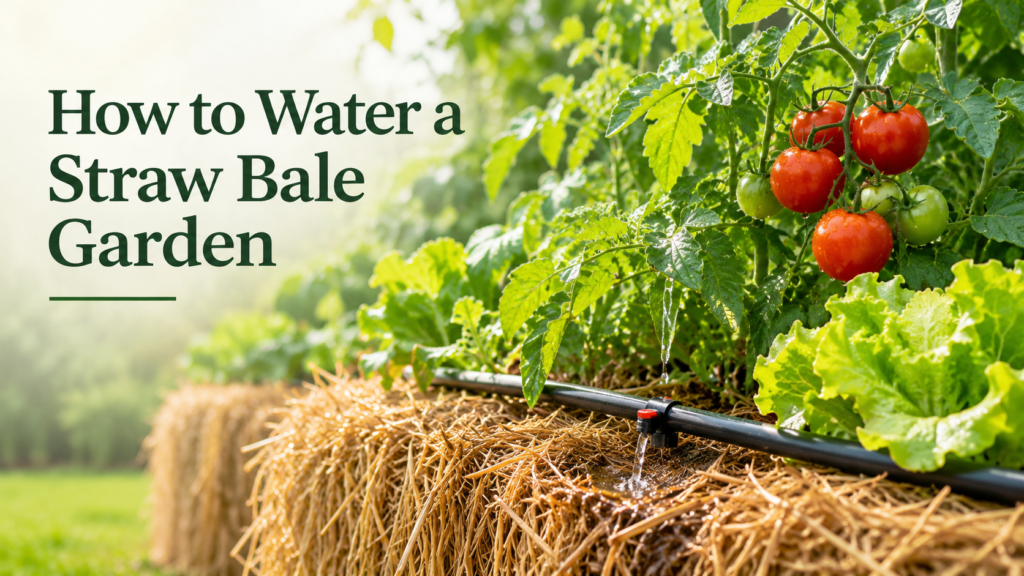
Watering a straw bale garden is simple once you understand one important rule: keep the bale consistently moist without constantly soaking it.
Straw bales hold moisture well as they begin decomposing, so adding more water is not always better. Too much water can simply run through the bale and carry nutrients with it.
The amount and frequency you need will change with the weather, the size of your plants, and what you are growing.
Here is how to get it right.
Quick Answer: How Much Water Does a Straw Bale Garden Need?
A useful starting point from the official Straw Bale Gardens beginner guidance is about one gallon of water per bale when irrigating.
That does not mean every bale needs exactly one gallon every single day.
Instead, adjust how often you water based on:
- Temperature
- Rainfall
- Wind
- Plant size
- Crop type
- How quickly the bale is drying
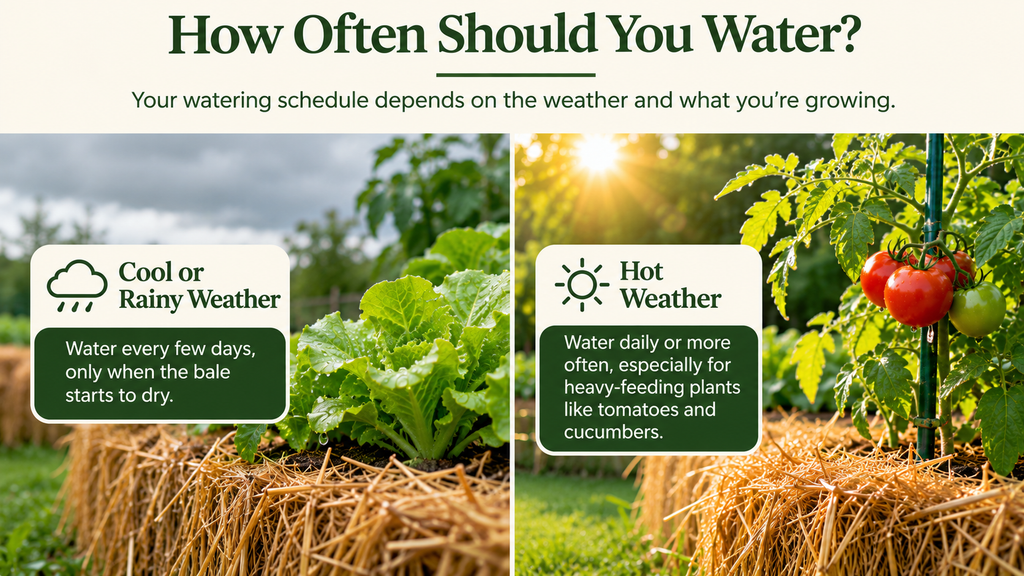
During cool or rainy weather, watering may only be necessary every few days. During hot summer conditions, the bales may need water daily.
The goal is moisture, not saturation.
Why Watering Straw Bales Is Different
A straw bale garden does not behave exactly like a traditional garden bed.
During conditioning, water and nutrients encourage microbial activity inside the bale. As the straw begins decomposing, the interior softens and develops into the growing environment your plants use.
Once plants are established, their roots grow into this moist, decomposing interior.
That means you need enough water to keep the root zone consistently supplied, but you do not need to flood the bale every time you irrigate.
In fact, too much water can work against you.
Can You Overwater a Straw Bale Garden?
Yes.
A bale can only hold so much water at once.
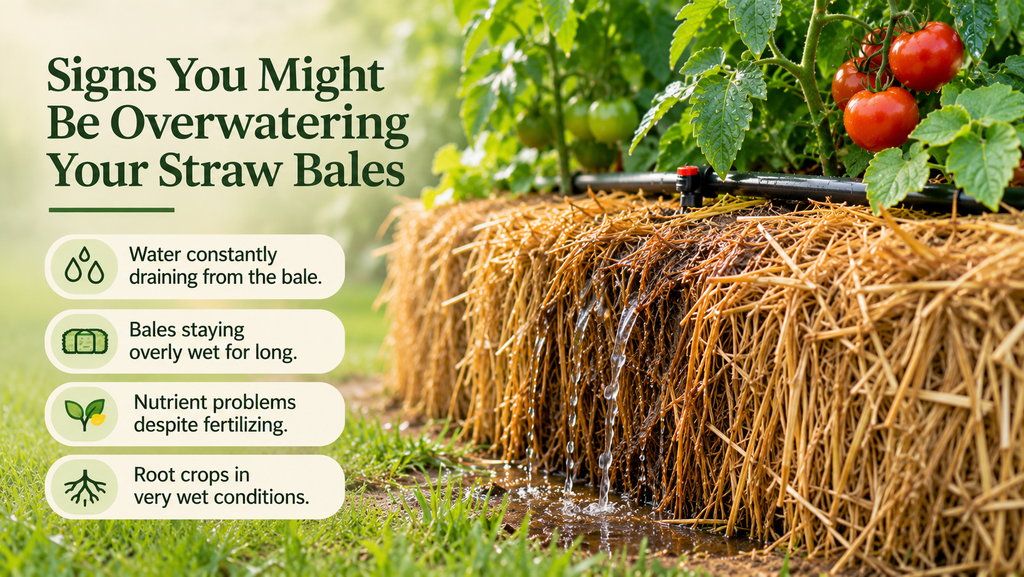
When you apply more than it can retain, the excess eventually drains from the bottom. Some drainage is normal, but repeatedly flushing large amounts of water through the bale can carry nitrogen and other nutrients away.
Joel Karsten explains this problem in the Straw Bale Garden Club’s irrigation system guide.
This is one reason watering more frequently with a controlled amount can work better than heavily soaking the garden at irregular intervals.
Signs you may be applying too much water
Watch for:
- Water constantly pouring from the bottom of the bales
- Bales staying excessively wet for long periods
- Repeated nutrient problems despite fertilizing
- Very wet conditions around root crops
The solution is not necessarily to stop watering completely.
Reduce the amount applied at one time and monitor the bale.
What Is the Best Way to Water a Straw Bale Garden?
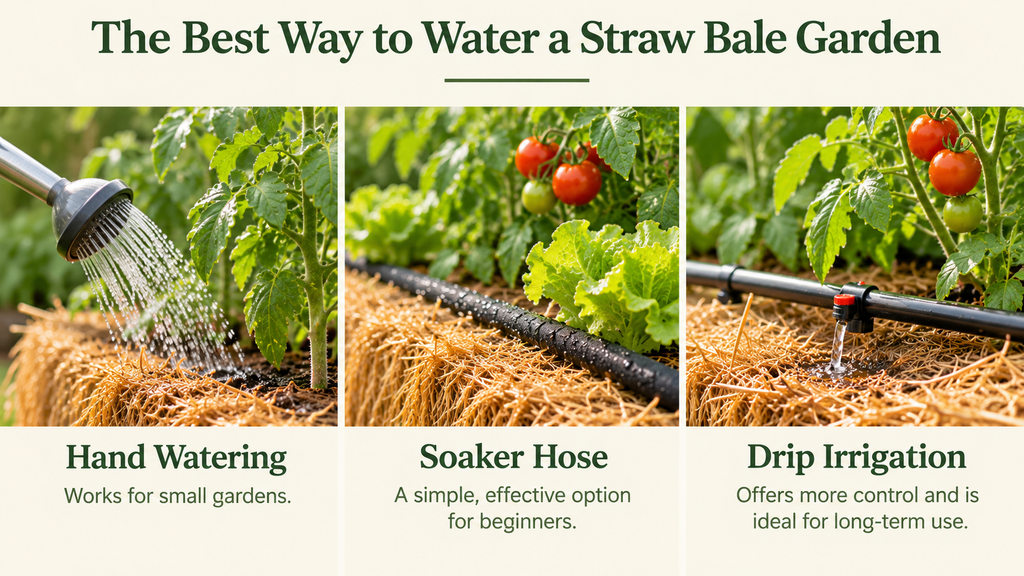
For a very small garden, a hose or watering wand can work.
However, for regular watering throughout the growing season, the official Straw Bale Gardening method strongly favors delivering water directly to the plants through either:
- A soaker hose
- A drip irrigation system
Both approaches put water where it is needed rather than spraying the entire garden.
Why avoid overhead watering?
Overhead watering wets leaves, pathways, and areas that do not need irrigation.
Drip or soaker irrigation concentrates the water around the bale and plant roots.
It also helps keep foliage drier.
The Straw Bale Garden Club explains that better airflow and keeping leaves dry can help reduce conditions that encourage disease and insect problems.
Option 1: Using a Soaker Hose
A soaker hose is one of the easiest watering systems for a beginner.
Run the hose along the center of your row of bales and secure it so that it remains in position.
The Basics of Straw Bale Gardening recommends placing a soaker hose down the center of the bale row and adding an automatic timer.
Advantages of a soaker hose
- Simple to install
- Relatively inexpensive
- Good for small gardens
- Waters the bale directly
- Can be connected to a timer
- Requires less daily effort than hand watering
The main limitation is durability. Joel notes that soaker hoses may need replacing after a season or two, while a properly installed drip system can last considerably longer.
For someone starting with only a few bales, however, a soaker hose can be more than enough.
Option 2: Using Drip Irrigation
If you want more control, drip irrigation is the stronger long-term setup.
Instead of watering the entire bale evenly, drip irrigation allows you to position emitters close to individual plants.
That becomes useful because different plants do not use water at exactly the same rate.
A simple system can include:
- A water source
- A timer
- A main supply line
- Branch lines running along the bales
- Emitters positioned near individual plants
Once installed correctly, much of the watering can happen automatically.
Different Plants Need Different Amounts of Water
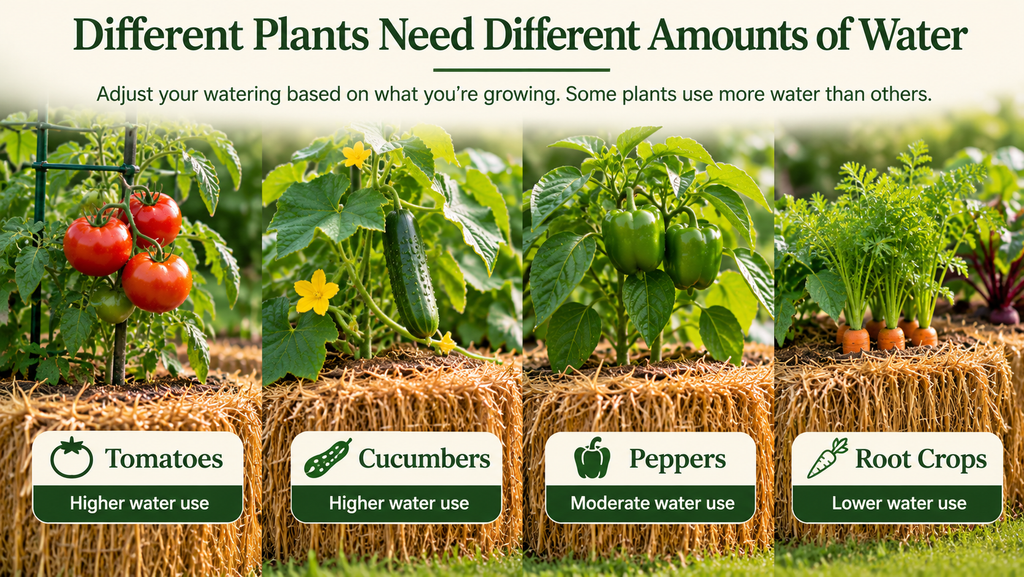
One of the biggest advantages of drip irrigation is that you can adjust water delivery based on what you grow.
In Joel Karsten’s own irrigation setup, he gives several examples.
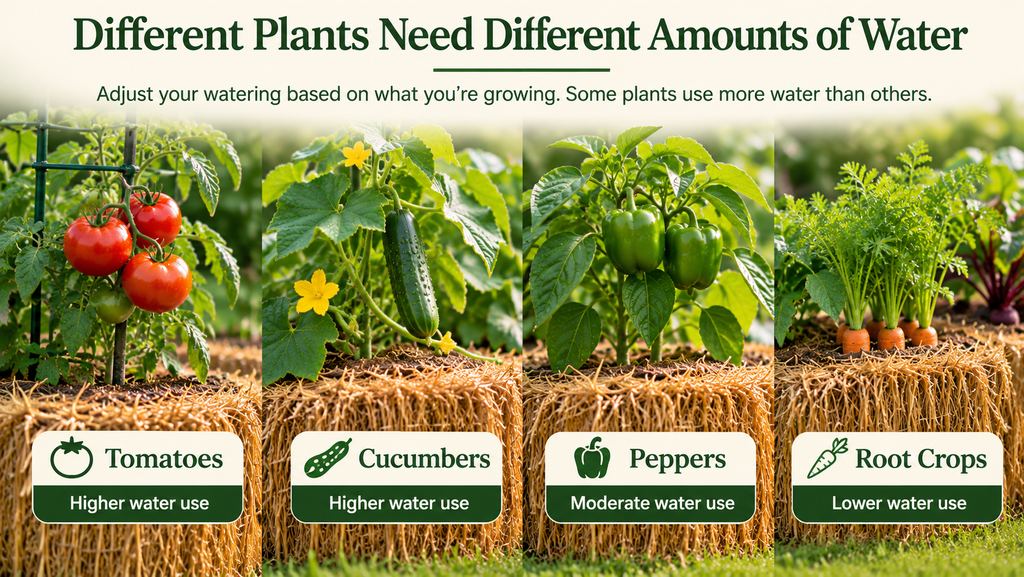
For tomatoes, he uses a higher-output emitter because tomatoes use plenty of water.
Peppers generally receive less.
Cucumbers also need significant moisture because the harvested fruit contains so much water.
Root crops such as potatoes and carrots generally require less water than juicy crops like tomatoes and cucumbers.
Joel also warns against overwatering root crops because excessively wet conditions can contribute to root problems.
Example emitter setup
In Joel’s system:
| Crop | Example emitter capacity |
| Tomato | 3 gallons per hour |
| Pepper | 2 gallons per hour |
| Cucumber | Around 2–3 gallons per hour |
| Root crops | Lower water demand |
These are emitter flow ratings, not instructions to run the system for a full hour.
Joel specifically notes that his irrigation usually operates for a much shorter period.
Use these numbers as examples of how plant demand can influence irrigation design rather than as a universal watering formula.
How Often Should You Water Straw Bales?
There is no single watering schedule that works everywhere.
Use the weather as your guide.
During cool or rainy weather
You may only need to water every few days.
Before turning on the irrigation, check whether the bale is still moist.
There is no advantage to adding water simply because the timer says it is time.
During hot weather
As temperatures rise and mature plants begin using more water, daily irrigation may become necessary.
Large tomato and cucumber plants can use considerably more moisture than small seedlings.
During very windy weather
Wind can increase moisture loss, so monitor exposed gardens more closely.
After rainfall
Do not automatically irrigate after a significant rain.
Check the bale first.
The correct schedule is the one that keeps the bale moist without repeatedly flushing water through it.
What Is the Best Time of Day to Water?
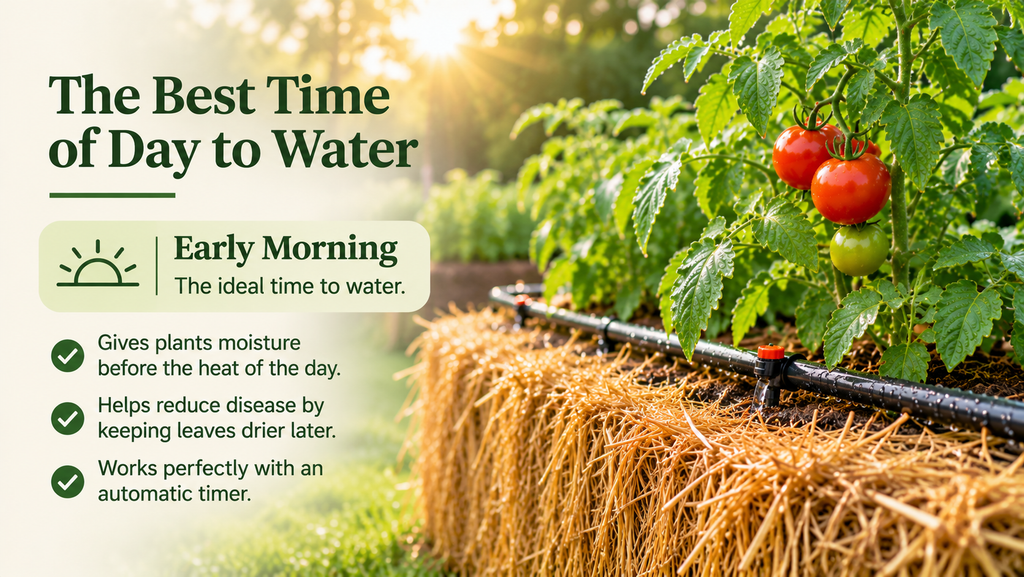
Early morning is the preferred time.
In Joel’s own automated irrigation setup, the system runs before sunrise.
Morning watering allows the plants to begin the day with available moisture while avoiding unnecessary leaf wetness later in the day.
You do not need to copy Joel’s exact 4:00 a.m. schedule.
The important principle is to water early and consistently rather than waiting for plants to become severely stressed during the hottest part of the day.
An automatic timer makes this much easier.
How to Set Up a Simple Watering System for a Small Straw Bale Garden
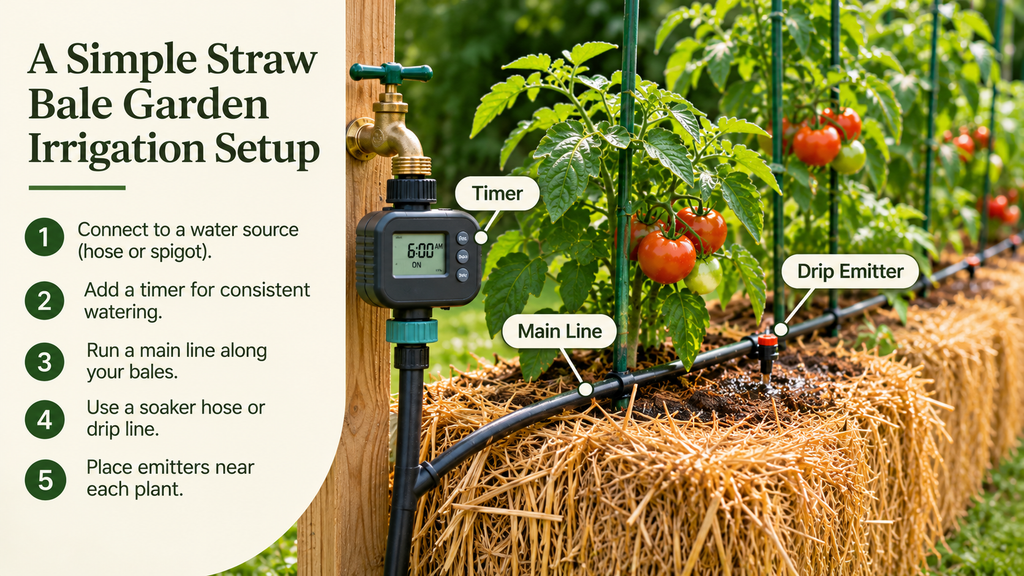
You do not need a complicated irrigation system for four or five bales.
A simple setup could look like this:
Water source → timer → hose → soaker hose or drip line → bales
Step 1: Position your bales first
Put the garden in its final location before adding irrigation.
Conditioned, wet bales become heavy.
Step 2: Make sure water can reach the garden
Water access should be part of your garden planning from the beginning.
A beautiful garden location becomes inconvenient very quickly if you have to carry water a long distance every day.
Step 3: Install the irrigation line
Run your soaker hose or drip line along the row.
With a drip system, position emitters close to the plants rather than far away from their root zones.
Step 4: Connect a timer
A timer removes much of the daily guesswork.
Program it for early morning watering, then adjust the duration based on weather and plant demand.
Step 5: Test the system
Run the system while you are present.
Check:
- Every emitter
- Water pressure
- Leaks
- Dry areas
- Excess runoff
Do not assume the entire system works simply because water is entering the first bale.
Watering Larger Straw Bale Gardens
A larger garden needs more planning.
Joel’s irrigation guidance suggests that gardens with fewer than roughly 25 bales can often operate as one watering zone.
Once you move beyond that size, pressure can become an issue.
For larger setups, dividing the irrigation system into multiple zones can help maintain more even water pressure.
For example:
Water source → manifold → timer → Zone 1 + Zone 2
Run the zones separately rather than simultaneously so each receives adequate pressure.
This becomes especially useful for:
- Community gardens
- School gardens
- Large backyard gardens
- Homestead gardens
- Gardens with several long rows
Check the End of the Irrigation Line
Water pressure often becomes more noticeable at the far end of a large irrigation system.
After installation, walk through the whole garden and inspect the final emitters.
If they produce much less water than the emitters near the beginning of the line, you may have:
- Too many emitters
- Insufficient pressure
- A clogged filter
- A leak
- Too many zones operating at once
Fix the distribution problem rather than simply increasing the watering time for the entire garden.
Using Well, Pond, or Lake Water
If your irrigation water contains sediment, protect the drip system with a filter or screen.
Small drip emitters can clog easily.
Joel recommends checking these screens when water pressure appears to drop.
If the system worked well before but suddenly becomes weak, inspect the filter before assuming the entire irrigation setup needs replacing.
Common Straw Bale Garden Watering Mistakes
1. Watering Too Much at Once
More water does not automatically mean healthier plants.
When water constantly runs through the bottom of the bale, it can take valuable nutrients with it.
2. Waiting Until Plants Wilt
Severe wilting means the plant is already under stress.
Aim for consistent moisture rather than repeatedly allowing the bale to become extremely dry.
3. Using the Same Amount for Every Plant
Tomatoes, cucumbers, peppers, potatoes, and carrots do not all use water in the same way.
A drip system makes it easier to adjust delivery around individual plants.
4. Watering the Entire Garden From Above
Most of that water is not helping the roots.
Direct the water into the bale where the plants can actually use it.
5. Forgetting to Adjust for Weather
A timer is useful, but it should not replace observation.
Reduce irrigation after rain or during cooler weather.
Increase frequency when hot weather and mature plants increase demand.
6. Putting the Garden Too Far From Water
Think about irrigation before placing your bales.
Moving a dry bale is easy.
Moving a conditioned, waterlogged bale is not.
Do You Water Differently During Conditioning?
Yes.
Conditioning and regular growing-season irrigation have different purposes.
During conditioning, water helps activate the decomposition process inside a fresh bale.
Once conditioning is complete and plants are growing, irrigation shifts toward maintaining a healthy root environment.
If you are still preparing fresh bales, follow the full Straw Bale Gardening setup and conditioning process before treating them like established garden beds.
Gardeners who still need to choose a conditioning product can compare the available options in Best BaleBuster Products and Starter Kits for Beginners.
Frequently Asked Questions
How much water does one straw bale need?
A useful starting guideline is approximately one gallon per bale when irrigating. Adjust frequency based on weather, plant growth, and moisture inside the bale rather than automatically adding more water.
Should I water my straw bale garden every day?
Not necessarily. Hot summer weather may require daily watering, while cool or rainy conditions may allow several days between watering.
Can you overwater straw bales?
Yes. Excess water can drain through the bale and leach nutrients. Apply enough to keep the bale moist without continually flushing water through it.
Is a soaker hose or drip irrigation better?
Both work. A soaker hose is inexpensive and simple, making it useful for smaller gardens. Drip irrigation offers greater control and can last longer when properly installed.
What time should I water a straw bale garden?
Early morning is a good choice. It gives plants access to moisture before the heat of the day and works particularly well with an automatic timer.
Should I use overhead sprinklers?
Direct watering through soaker hoses or drip irrigation is generally preferable because it puts moisture at the roots rather than wetting the entire garden and plant foliage.
Does a twenty-bale garden need a different watering system?
Not necessarily, but larger gardens require more attention to pressure. Once a garden grows beyond roughly 25 bales, dividing irrigation into multiple zones can make water distribution more consistent.
Make Watering Easier, Not Harder
A successful straw bale garden does not need constant hand watering.
Start with the basics:
Keep the bales consistently moist.
Avoid flooding them.
Water according to the weather.
Give high-water-use plants more attention.
And when possible, use a soaker hose or drip irrigation system connected to a timer.
A simple watering setup can save time for the entire season and help you spend less time carrying hoses and more time actually enjoying the garden.
If you are still preparing your garden, use the BaleBuster product and starter kit guide to choose the conditioning option that matches your number of fresh bales.