
If your straw bale garden has reached the end of its first growing season, you may be wondering what happens next. Do you need to replace every bale, or can some of them be used again?
The answer is simple: some straw bales can be reused for a second season, but it depends on how much structure they have left and what you plan to grow.
A second-year bale is very different from a fresh bale. Understanding that difference will help you decide whether to reuse it, start with new bales, or turn the old material into valuable compost..
What Happens to a Straw Bale During the First Season?
A straw bale does not remain unchanged while your plants grow.
Before planting, fresh bales are conditioned with water and nutrients. This encourages microorganisms inside the bale to begin breaking down the straw. Over time, the inside becomes softer and more compost-like, creating a growing environment for plant roots.
That decomposition continues throughout the growing season.
By the end of the year, you may notice that your bales are:
- Softer than they were in spring
- Lower or more compressed
- Beginning to lose their original shape
- Filled with partially decomposed straw
- Looking increasingly like compost inside
All of this is normal. In fact, decomposition is an essential part of the Straw Bale Gardens method.
Can You Reuse a Straw Bale Next Year?
Yes, if the bale still has enough structure to function as a growing container.
Official Straw Bale Gardens guidance notes that partially decomposed second-year bales can still be useful for another growing season. These older bales can work particularly well for cool-season crops such as lettuce, spinach, carrots, and potatoes.
However, not every bale will make it through the first year in the same condition.
Before deciding, inspect each bale individually.
How to Tell if Your Bale Can Be Reused
Look at the bale before spring planting.
A second-year bale may still be worth using when:
- Much of the bale still holds together
- The remaining straw is contained well enough for planting
- The bale has not completely collapsed
- You can keep the growing area stable
- The old material is still deep enough to support your plants
If the bale has started spreading apart, that does not automatically mean it is finished.
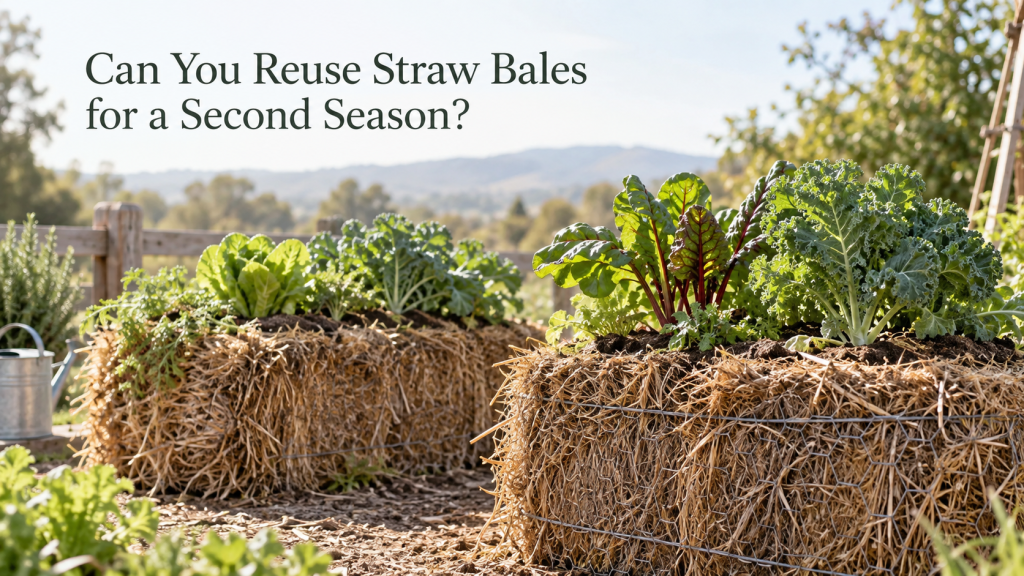
The Straw Bale Gardens method recommends wrapping an older bale with chicken wire when it begins losing its shape. The wire can be secured with a wooden stake to help keep the decomposing material together and prevent roots from becoming exposed.
Do Second-Year Bales Need to Be Conditioned Again?
This is one of the most important differences between a new bale and a reused bale.
A sufficiently decomposed second-year bale does not need to go through the same conditioning process as a fresh bale.
The first season has already done much of that work. The straw has been exposed to water, nutrients, microorganisms, plant roots, and months of decomposition.
That means you should not simply repeat the fresh-bale conditioning process automatically.
Instead, evaluate the condition of the old bale and follow the appropriate second-year growing guidance.
If you are adding new, fresh bales to your garden, those new bales still need to be properly conditioned before planting.
What Should You Grow in Second-Year Bales?
Second-year bales behave differently because they no longer generate as much heat as fresh bales during active decomposition.
That can make them particularly useful for crops that do not depend on the warmer environment created inside newly conditioned bales.
Good options mentioned in Straw Bale Gardens guidance include:
- Lettuce
- Spinach
- Carrots
- Potatoes
Fresh bales may be preferable for warm-season crops that benefit from the heat generated during first-year decomposition. Joel Karsten’s guidance specifically notes crops such as tomatoes, cucumbers, squash, and peppers as plants that can benefit from new bales.
The practical lesson is not that second-year bales are bad. They simply behave differently from fresh ones.
When Should You Start With Fresh Bales?
Sometimes the simplest choice is to begin again.
Use fresh straw bales when the old ones have decomposed so far that they can no longer provide a stable growing container.
For example, starting fresh may make more sense when:
The bale has almost completely fallen apart
Very little recognizable bale structure remains
The material cannot be contained easily
You want the predictable structure of a new bale
You are primarily growing warm-season crops that benefit from first-year decomposition
Fresh bales also allow you to start the Straw Bale Gardens process from the beginning, including proper placement and conditioning.
Can You Mix New and Old Bales?
Yes.
You do not have to make the entire garden either new or second-year.
For example, you could keep a few older bales that are still structurally sound for cool-season crops while replacing heavily decomposed bales with fresh ones.
This gives you a practical way to reuse suitable material without depending on worn-out bales for your whole garden.
Just remember that the two types of bales are at different stages.
Fresh bales need conditioning. Second-year bales have already undergone substantial decomposition.
Treat them accordingly.
What if the Old Bale Is Falling Apart?
If the material is still usable but no longer holds its original shape, chicken wire can help.
Wrap the remaining bale material so that it stays contained. Then secure the wire with a wooden stake driven into the ground.
This can extend the useful life of a second-year bale and keep the planting area stable.
However, there comes a point when the material has decomposed enough that trying to preserve it as a bale no longer makes sense.
That is not a loss.
At that stage, you have something else that gardeners value greatly: compost.
What Should You Do With Bales That Cannot Be Reused?
One of the advantages of straw bale gardening is that the material does not have to become waste when the growing season ends.
As the straw continues breaking down, it becomes increasingly compost-like.
Spent straw bale material can be:
- Added to a compost pile
- Used as organic material around garden areas
- Used as mulch where appropriate
- Incorporated into other growing areas
- Allowed to finish decomposing for later garden use
Joel Karsten describes the decomposed material left after a Straw Bale Garden as valuable compost that can be used elsewhere in the landscape and garden.
So even a bale that cannot support another season of plants still has value.
Fresh Bale or Second-Year Bale: Which Should You Choose?
Here is the easiest way to decide.
| Condition | Best approach |
| Bale still holds together well | Consider using it for a second season |
| Bale is weakening but still usable | Reinforce it with chicken wire |
| Bale has almost completely collapsed | Use the material as compost |
| Growing cool-season crops | A second-year bale may work well |
| Growing warm-season crops | Fresh bales may provide better conditions |
| Adding brand-new bales | Condition the fresh bales before planting |
The goal is not to force every bale into a second season.
Use what remains useful and replace what no longer provides a practical growing container.
Do You Need BaleBuster for a Second-Year Bale?
A second-year bale that has already decomposed significantly is different from a fresh bale and generally does not require the original conditioning process again.
BaleBuster is therefore most relevant when you are starting with fresh straw bales that need to be conditioned for planting.
If some of your old bales are ready for the compost pile and you are replacing them with fresh bales, choose the BaleBuster option that matches the number of new bales you need to condition.
This is a much cleaner sales connection because it recommends BaleBuster where the product is actually relevant rather than suggesting that already-decomposed second-year bales should be conditioned again.
Frequently Asked Questions
How many years can you reuse a straw bale?
It depends on how quickly the bale decomposes and whether it still has enough structure to work as a planting container. Some bales can remain useful for another growing season, while others may be too decomposed after the first year.
Do you have to condition a straw bale again in the second year?
Not usually when the bale has already decomposed substantially during its first season. Second-year bales have already undergone the conditioning and decomposition process.
What can you plant in an old straw bale?
Second-year bales can work especially well for crops such as lettuce, spinach, carrots, and potatoes.
What should you do if the bale starts falling apart?
Wrap chicken wire around the bale and secure it with a wooden stake if there is still enough material to continue growing in it.
What can you do with completely decomposed straw bales?
Allow the material to finish composting and use it elsewhere in the garden. Spent straw can become useful organic matter rather than being thrown away.
Make the Most of Next Season
You do not automatically have to throw away every bale after one growing season.
Inspect what remains.
If a bale still has enough structure, consider giving it another season. If it is beginning to fall apart, reinforce it where practical. And when a bale has finally finished its job as a growing container, let the decomposed material continue its life as useful compost.
For the fresh bales you add next season, proper conditioning remains one of the most important steps before planting.
Planning a fresh setup? Compare BaleBuster products and choose the package that matches the number of new bales you plan to condition.