
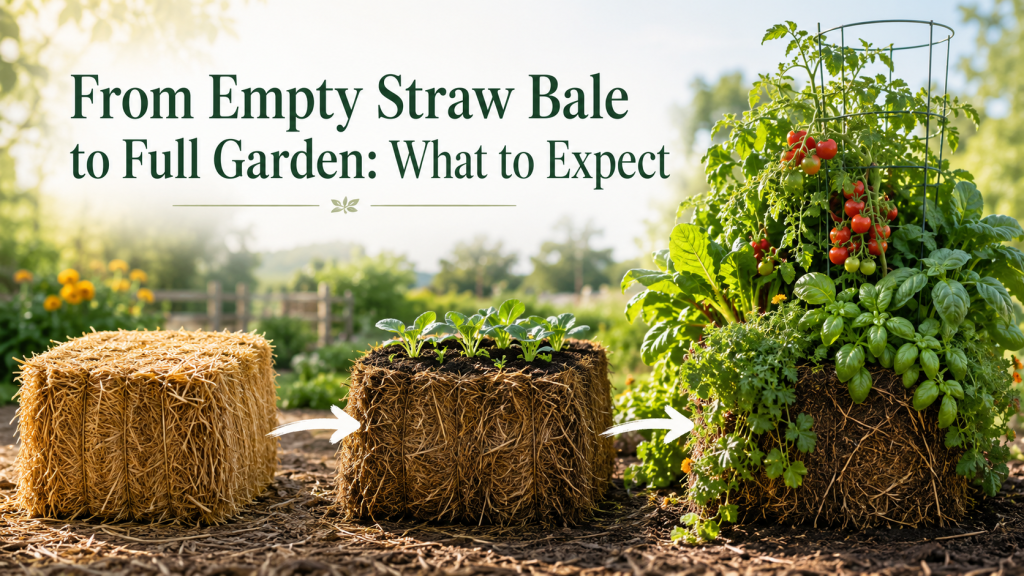
A straw bale garden does not look impressive on day one.
At the beginning, it is just a dry bale sitting in your yard, patio, driveway, or garden space. There may be no plants, no flowers, no vegetables, and no sign of the full garden it can become later.
But that is the interesting part of straw bale gardening.
The transformation happens in stages.
First, the bale is placed.
Then it is conditioned.
Then it begins breaking down inside.
Then the plants go in.
Then the roots settle, the leaves expand, and the garden starts to look alive.
If you are new to this method, it helps to know what to expect before you begin. That way, you do not panic when the bale looks unchanged during conditioning, when it warms up inside, when it softens, or when it starts breaking down later in the season.
This guide walks you through the journey from an empty straw bale to a full garden, so you can understand what is normal, what needs attention, and what to buy before you start.
Stage 1: The Empty Bale
Every straw bale garden starts with the bale itself.
At this stage, the garden does not look like much. You may have one bale sitting in a sunny corner, four bales arranged as a small starter garden, or several bales lined up for a bigger setup.
The important thing is placement.
Before the bale gets wet and heavy, decide where it will stay for the season. Choose a spot with good sunlight and easy access to water. Once conditioning begins, moving the bale becomes much harder.
This is also the point where you should decide how many bales you are actually preparing.
That decision matters because your bale count determines which BaleBuster product fits your setup.
For one bale, BaleBuster1 is the one-bale organic option listed on the shop.
For a four-bale starter garden, BaleBuster4 is made for conditioning four average-size bales.
For a larger garden, BaleBuster20 is the twenty-bale option.
This is the first step: count the bales, place them well, and choose the right conditioning product before planting is even considered.
Stage 2: The Bale Begins Conditioning
This is where the garden starts changing, even if you cannot see much happening on the outside.
Conditioning is the preparation stage that helps the bale become suitable for planting. The Straw Bale Gardens method explains that once the straw inside the bale begins to decay, it becomes conditioned compost that creates a strong rooting environment for plants. You can read more about the method on the main Straw Bale Gardens education site.
During this stage, you are not planting yet.
You are preparing.
The bale receives water and the right conditioning support so the inside can begin breaking down. This is what turns the bale from dry straw into a living growing medium.
What you may notice during conditioning:
- The bale becomes heavier.
- The top may feel damp.
- The inside may begin to warm.
- The bale may look mostly the same from the outside.
- The straw may start softening gradually.
One thing beginners should understand is this: the bale does not need to look dramatically different right away.
A lot of the action happens inside.
The bacteria and decomposition process are working below the surface, preparing the bale for roots.
Stage 3: The Waiting Period
This is the part that tests patience.
You have the bales in place. You have started conditioning. You are watering. You may be checking the bales every day and wondering whether anything is happening.
This is normal.
Straw bale gardening is simple, but it is not instant. The bale needs time before planting.
The How to Start Straw Bale Gardening guide explains that the conditioning process should begin before planting, and the timing can depend on your location and planting season.
Weather can also affect how quickly things move. If the weather is cool, the bacteria inside the bale may work more slowly. The Straw Bale Gardens article on bales not getting hot explains that colder air slows bacterial growth and that gardeners may need to add more time when temperatures are lower. You can read that guidance in My bales are not getting hot, am I doing something wrong?.
So during this stage, do not judge the garden only by appearance.
Instead, focus on consistency.
Keep the bale moist according to the method. Follow the product directions. Give the bale enough time. Do not rush into planting just because the weather looks good for one day.
Stage 4: The Bale Starts Feeling Alive
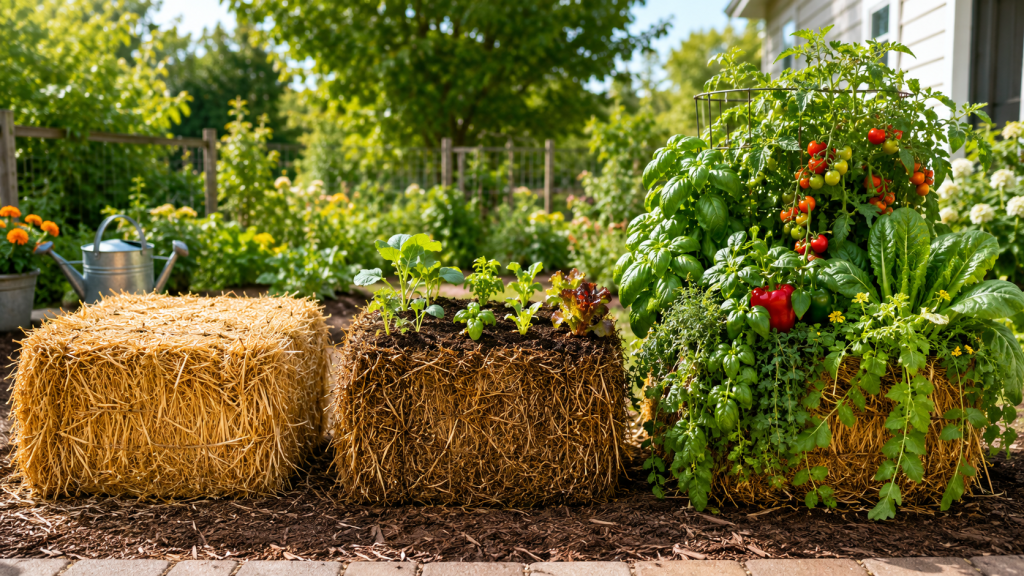
At some point during conditioning, the bale begins to feel less like a dry block of straw and more like a growing environment.
You may notice that the inside feels warmer than the outside. The straw may loosen slightly. Water may absorb better than it did at first. The top may become easier to open for planting.
This is a good sign.
It means the bale is moving toward the stage where roots can grow into it.
The change may not be dramatic, but it matters.
A properly prepared bale gives plants a better place to settle. The roots do not have to fight through dry, stiff straw. They begin growing into a bale that has started breaking down inside.
This is also a good time to prepare the rest of your supplies.
Before planting, make sure you have:
- Seedlings or seeds
- A hand trowel
- Garden gloves
- Watering can or hose
- Plant supports if needed
- Labels if growing several crops
If you are a beginner and want product plus method guidance, the BaleBuster4 Starter Kit includes BaleBuster4 with the Straw Bale Gardens Complete book.
Stage 5: Planting Day
Planting day is when the empty bale finally starts looking like a garden.
This is the point where seedlings, seeds, herbs, flowers, or vegetables go into the prepared bale.
If you are using seedlings, create small planting pockets in the top of the bale. Place the root ball into the opening and settle it in carefully.
If you are using seeds, you may need a small amount of planting mix on top of the bale so the seeds have a better surface for germination.
This is where the project begins to feel rewarding.
The bale that looked plain at the start now has life coming out of it.
But even after planting, the garden is still in its early stage. The plants need time to adjust. The roots need time to move into the bale. Watering still matters. Plant support may become important soon, especially for crops like tomatoes or cucumbers.
Do not expect the garden to look full immediately.
The first few days after planting are about establishment.
Stage 6: Early Growth
After planting, you should begin seeing the plants settle in.
Leaves may perk up. New growth may appear. The seedlings may look more comfortable as roots begin exploring the conditioned bale.
This early growth stage is important because it tells you whether the plants are adjusting well.
What you want to see:
- Leaves standing upright
- Fresh new growth
- Plants holding moisture well
- Roots beginning to settle
- No major wilting after watering
If a plant looks stressed right after transplanting, do not panic immediately. Some transplant shock can happen. Give it a little time, keep the bale properly watered, and check whether the plant improves.
If several plants are struggling, look at the basics:
- Was the bale conditioned long enough?
- Is the bale too dry?
- Is the bale too wet?
- Did the weather turn cold?
- Are the plants getting enough sunlight?
The first two weeks after planting give you early clues about how the garden will perform.
Stage 7: The Garden Starts Filling In
This is the stage most gardeners are waiting for.
The plants begin spreading. Leaves become fuller. Taller crops start reaching upward. Herbs begin filling their space. Flowers may start forming. Vegetables begin setting early growth.
The garden now looks less like bales with plants on top and more like a real growing system.
A four-bale setup can feel especially satisfying at this stage because each bale starts taking on a different role.
One bale may hold tomatoes.
Another may hold herbs.
Another may support peppers.
Another may grow greens or flowers.
This is where the planning from the beginning pays off.
If you grouped crops well, left walking space, planned water access, and added supports early, the garden becomes easier to manage.
If the bales were crowded too tightly, you may start noticing the problem now.
This is why layout matters from day one.
Stage 8: Support and Maintenance
As the garden grows, some plants will need help staying upright.
Tomatoes, cucumbers, squash, and other large or climbing plants may need cages, stakes, trellises, or ties. It is better to add support early than to wait until plants are leaning or tangled.
Maintenance at this stage is simple, but it should be regular.
Check the garden for:
- Moisture
- Plant growth
- Loose supports
- Yellowing leaves
- Pest signs
- Plants shading one another
- Bales leaning or softening
The bales will continue breaking down as the season moves forward. That is expected. They may become softer, shorter, or less square than they were in the beginning.
This does not mean the garden is failing.
It means the bale is continuing its natural process.
If a bale begins leaning too much, you can support it with stakes, twine, or wire depending on the setup.
Stage 9: Harvest Time
This is where the empty bale transformation becomes clear.
The same bale that started as dry straw can now support vegetables, herbs, or flowers.
Depending on what you planted, you may begin harvesting greens first, then herbs, peppers, cucumbers, tomatoes, or other crops as the season continues.
Harvesting from straw bales can be easier than harvesting from traditional ground beds because the plants are raised higher. There is usually less bending, and the garden can feel cleaner and more accessible.
At this stage, keep harvesting regularly.
Picking mature produce encourages some plants to keep producing. Removing finished leaves or spent flowers can also keep the garden looking healthier.
This is the full-garden stage: the point where the bale is no longer the focus.
The plants are.
Stage 10: The Bale Breaks Down Further
By the end of the growing season, the bales may look tired.
They may be darker, softer, partly collapsed, or loose. Some may barely look like the original bales anymore.
That is normal.
The bale has been working all season.
It has held water, supported roots, and continued decomposing. By the end, the remaining material can often be reused as compost, mulch, or organic matter for other garden areas.
Do not think of the end-of-season bale as waste.
Think of it as the final stage of the garden cycle.
The bale starts as straw.
It becomes a growing medium.
It supports plants.
Then it becomes useful organic material.
That is part of what makes the method practical.
What to Expect If This Is Your First Straw Bale Garden
Your first season is also a learning season.
You may not get everything perfect.
Maybe you start a little late. Maybe you wish you had used four bales instead of one. Maybe you realize you need better watering access. Maybe your tomatoes need stronger support than you expected.
That is fine.
The goal of the first season is not perfection. The goal is to understand the rhythm of the method.
You will learn:
- How bales change during conditioning
- How often your garden needs water
- Which crops you enjoy growing
- How much space your plants need
- Whether you want to expand next season
- Which BaleBuster size fits your future garden plan
If you started with BaleBuster1 and enjoyed the process, you may decide to move to BaleBuster4 next season.
If four bales worked well and you want more growing space, then BaleBuster20 may make sense for a larger setup.
The method can grow with you.
What Not to Worry About
New gardeners often worry too early.
Here are a few things that may be normal:
The bale looks the same during early conditioning.
The inside feels warm.
The bale softens over time.
The bale becomes less square during the season.
The surface looks messy after weeks of watering and growth.
The bale breaks down near the end of the year.
These are part of the process.
What you should pay more attention to is whether you followed the conditioning process, whether the bale has consistent moisture, whether plants are settling after planting, and whether the garden is getting enough sun.
Product Path for Different Garden Sizes
Here is the simplest way to choose what to buy before starting.
For a one-bale test garden, use BaleBuster1.
For a small garden with four average-size bales, use BaleBuster4.
For a four-bale setup plus full guidance, choose the BaleBuster4 Starter Kit.
For a larger twenty-bale garden, use BaleBuster20.
For learning before buying, start with the official resources on Straw Bale Gardens.
Final Thoughts
Going from an empty straw bale to a full garden is a process.
At first, the bale may not look like much. But once it is placed, conditioned, planted, watered, and cared for, it becomes a productive growing space.
The key is knowing what to expect at each stage.
The bale will change.
The plants will need time.
The garden will fill in gradually.
The structure will soften as the season continues.
And by the end, the bale can still be useful as organic material.
Start with the right product for your bale count, give the conditioning process enough time, and let the garden develop stage by stage.
A full straw bale garden does not happen in one day.
It grows into itself.