
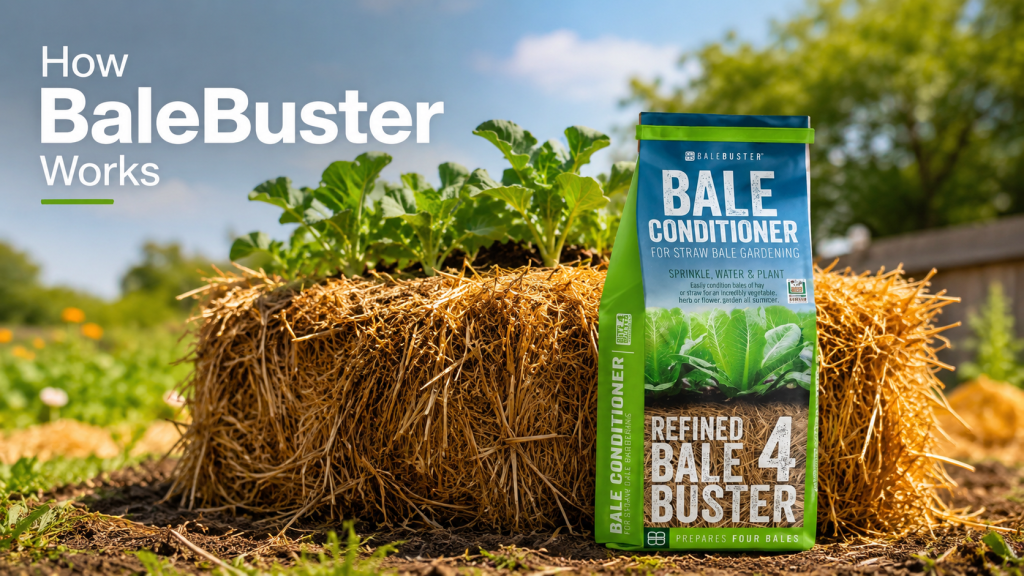
BaleBuster makes straw bale gardening easier by helping prepare the bale before planting.
That preparation stage matters because a fresh straw bale is not ready for plants right away. It needs moisture, nutrients, and time. Once the conditioning process begins, the inside of the bale starts to break down and becomes a better place for roots to grow.
That is the simple idea behind BaleBuster.
It supports the process that turns dry straw into a living growing space.
If you are new to straw bale gardening, this guide will walk you through how BaleBuster works, what happens inside the bale, and how to choose the right product for your garden size.
What BaleBuster Is Designed to Do
BaleBuster is made for the bale conditioning stage.
Conditioning prepares straw or hay bales before planting. During this stage, the bale receives water and nutrients so the microbes inside can begin breaking down the straw.
The goal is not to plant into dry straw.
Instead, the goal is to help the bale become a warm, moist, active growing environment.
The Straw Bale Gardens guide on how to start straw bale gardening explains that straw bales are conditioned with nutrients that feed beneficial bacteria inside the bale. These bacteria consume and metabolize straw fibers, gradually turning them into organic material similar to compost.
BaleBuster helps support that process.
It gives gardeners a more direct way to prepare the bale, instead of guessing with random fertilizers or trying to build their own conditioning routine from scratch.
Step 1: Choose the Right BaleBuster Product
BaleBuster works best when you choose the right product for your bale count.
This is the first step because each garden size needs the right amount of conditioning support.
If you want to condition one bale, BaleBuster1 fits that setup. The shop lists it as a one-bale organic formula.
For a four-bale starter garden, BaleBuster4 is the direct match. It is made for conditioning four average-size bales.
Larger gardens need a bigger option. If you plan to prepare twenty bales, BaleBuster20 is the twenty-bale product listed on the shop.
Your buying decision should start with one question:
How many bales am I preparing?
Once you answer that, the product choice becomes simple.
Step 2: Place the Bales Before Conditioning
Bales become heavy once watering begins.
So, place them where they will stay before applying BaleBuster.
Choose a spot with good sunlight and easy access to water. Also, leave enough space to walk around the bales. You will need that space later for watering, planting, pruning, and harvesting.
For a one-bale garden, this may be simple.
A four-bale setup needs a little more planning. Larger gardens need proper rows, paths, and a watering plan.
Good placement helps the whole season feel easier.
A bale placed far from water may look fine on day one, but it can become frustrating when conditioning starts. Keep the setup practical from the beginning.
Step 3: Add BaleBuster During the Conditioning Stage
BaleBuster enters the process before planting.
During conditioning, you apply the product to the bale and water it in according to the product instructions.
That part is important.
Water helps move the formula into the bale. It also gives microbes the moisture they need to become active. Without enough moisture, the breakdown process slows down.
However, more water does not always mean better results.
The bale should stay moist, not flooded. Too much water can reduce airflow inside the bale, and microbes need both moisture and oxygen to work well.
Think of watering as support.
It helps carry the nutrients into the bale and keeps the biological process moving.
Step 4: Microbes Begin Working Inside the Bale
This is where BaleBuster starts to make sense.
Once the bale has moisture and nutrients, microbes begin working inside the straw. Bacteria and fungi help break down the straw fibers and move the bale toward a compost-like state.
The article on where plants get nutrients in a straw bale explains that conditioning builds up bacteria inside the bale until they colonize it. Then, those bacteria begin consuming and digesting the straw.
That means the bale is not just sitting there.
It is changing from the inside.
The straw begins to soften. The center may become warm. Moisture starts moving differently through the bale. Over time, the material becomes more useful for roots.
This is the hidden work behind straw bale gardening.
Step 5: The Bale Starts to Warm
Many gardeners notice heat during conditioning.
That heat comes from microbial activity.
As microbes feed and multiply, they release warmth while breaking down the straw. The process is similar to what happens in a compost pile.
A warm bale usually shows that the internal process has started.
Even so, heat alone does not mean the bale is ready for planting. During the strongest heating stage, the inside may still be too active for young roots.
Wait until the bale has completed the right conditioning period and the strongest heat has settled.
A gently warm bale can be a good sign.
An extremely hot bale may need more time before seedlings go in.
Step 6: The Straw Begins to Soften
Fresh straw feels stiff and dry.
After conditioning begins, the interior changes. The straw becomes easier to separate, and the planting area feels less rigid.
This softness matters because roots need room to grow.
Plants cannot thrive well in straw that still feels hard, dry, and unchanged. They need a bale that has started opening up inside.
You do not need the bale to turn into finished compost before planting. That will not happen immediately.
Still, the inside should feel more workable than it did at the start.
If the center feels moist, slightly warm, and softer, the process is moving in the right direction.
Step 7: Nutrients Become More Available
Straw contains organic material, but plants cannot use it properly until decomposition begins.
That is why conditioning matters.
As microbes break down the straw, nutrients become more available in the growing environment. The bale slowly moves from dry plant material toward a more active organic medium.
This process helps explain why the method works.
You are not simply growing plants in straw. You are growing in a bale that has started decomposing from the inside.
BaleBuster helps support that transition by feeding the conditioning process.
The product does not replace good watering, sunlight, or timing. Instead, it helps create the conditions that allow the bale to become plantable.
Step 8: You Wait Until the Bale Is Ready
Good conditioning takes patience.
Planting too early can weaken the garden. The bale may look wet from the outside, but the inside may not be ready yet.
Before planting, check for signs of readiness.
The bale should have gone through the recommended conditioning window. It should feel moist inside. The straw should feel softer than it did at the start. Warmth may appear during the process, but the strongest heat should settle before seedlings go in.
If your bale still feels dry, cold, or stiff, give it more time.
Rushing the process can cost you more than waiting a few extra days.
Step 9: Plant Into the Prepared Bale
Once the bale is ready, planting becomes easier.
You can create planting pockets in the top of the bale and place seedlings where they have room to grow. Some gardeners use seeds for certain crops, while others prefer transplants.
At this stage, the bale should already offer a better root environment than it did when fresh.
Keep watering after planting.
The bale still needs moisture to support plant growth and ongoing decomposition. As the season continues, the inside keeps changing, and plant roots grow into the softened material.
The garden now moves from conditioning into growing.
Step 10: Keep Supporting the Garden Through the Season
BaleBuster starts the process, but the gardener still manages the season.
After planting, keep an eye on moisture, plant support, and crop growth. Tomatoes, cucumbers, and other tall plants may need cages or trellises. Smaller crops may need less structure, but they still need regular care.
Check the bales often during warm weather.
A bale can dry out faster when plants grow large and temperatures rise. Watering becomes especially important as roots spread and crops begin producing.
Good results come from the full system working together.
BaleBuster supports conditioning. Water keeps the process active. Sunlight powers plant growth. Proper spacing and support help crops stay healthy.
Why Product Size Matters
Using the wrong product size can make conditioning harder.
A product made for one bale should not be stretched across four bales. Likewise, a small starter garden does not need a twenty-bale box unless you plan to expand.
Match the product to the garden.
For one bale, use BaleBuster1.
Then for four bales, choose BaleBuster4.
For twenty bales, go with BaleBuster20.
If you are new and want the conditioning product plus the method in one bundle, the BaleBuster4 Starter Kit includes BaleBuster4 with Straw Bale Gardens Complete.
That can help beginners understand the process before they start planting.
What BaleBuster Helps You Avoid
BaleBuster helps reduce guesswork.
Without a product designed for bale conditioning, beginners often wonder what to use, how much to apply, and whether the bale is changing properly.
That confusion can lead to common mistakes.
Some gardeners use too little nutrient support. Others overwater. A few plant before the bale is ready. Some buy a product that does not match their bale count.
A clearer system helps prevent those problems.
BaleBuster does not remove every responsibility from the gardener. You still need to place the bales well, water properly, and wait for the conditioning process.
However, it gives you a more focused starting point.
Common Mistakes When Using BaleBuster
Buying before counting bales
Always decide your bale count first.
Planting too soon
The bale needs time to condition before plants go in.
Letting the bale dry out
Moisture helps microbes work through the straw.
Flooding the bale
Too much water can reduce airflow inside the bale.
Moving bales after watering
Wet bales become heavy and harder to reposition.
Ignoring the instructions
Follow the product directions for the specific BaleBuster option you buy.
Quick Step-by-Step Summary
Here is the simple version:
- Decide how many bales you want.
- Choose the matching BaleBuster product.
- Place the bales in a sunny spot near water.
- Apply BaleBuster during conditioning.
- Water it into the bale.
- Let microbes begin breaking down the straw.
- Watch for warmth, moisture, and softening.
- Wait until the strongest heat settles.
- Plant when the bale is ready.
- Keep watering and supporting the garden through the season.
That is how BaleBuster fits into the straw bale gardening process.
It helps prepare the bale before planting, so the garden starts with a stronger foundation.
FAQ: How BaleBuster Works
What does BaleBuster do?
BaleBuster helps condition straw bales before planting. It supports the microbial process that helps break down straw and prepare the bale for plant roots.
Do I still need to water the bale?
Yes. Water is part of the conditioning process. It helps move the product into the bale and supports microbial activity.
Can I plant immediately after using BaleBuster?
No. The bale needs time to condition before planting. Wait until the bale has gone through the preparation process and shows signs of readiness.
Which BaleBuster product should I buy?
Choose based on bale count. BaleBuster1 fits one bale, BaleBuster4 fits four bales, and BaleBuster20 fits twenty bales.
Why does the bale get warm?
The bale warms because microbes become active inside and begin breaking down the straw. That warmth is part of the conditioning process.
Final Thoughts
BaleBuster works by supporting the most important stage of straw bale gardening: conditioning.
It helps feed the process that allows microbes to break down straw and turn the inside of the bale into a better growing environment.
The method becomes easier when you follow the right order.
Count your bales.
Choose the matching BaleBuster product.
Place the bales before watering.
Condition before planting.
Wait until the bale is ready.
Then plant into a growing space that has already started changing from the inside.
That is the real value of BaleBuster. It helps gardeners begin with a prepared bale, not a dry block of straw.