
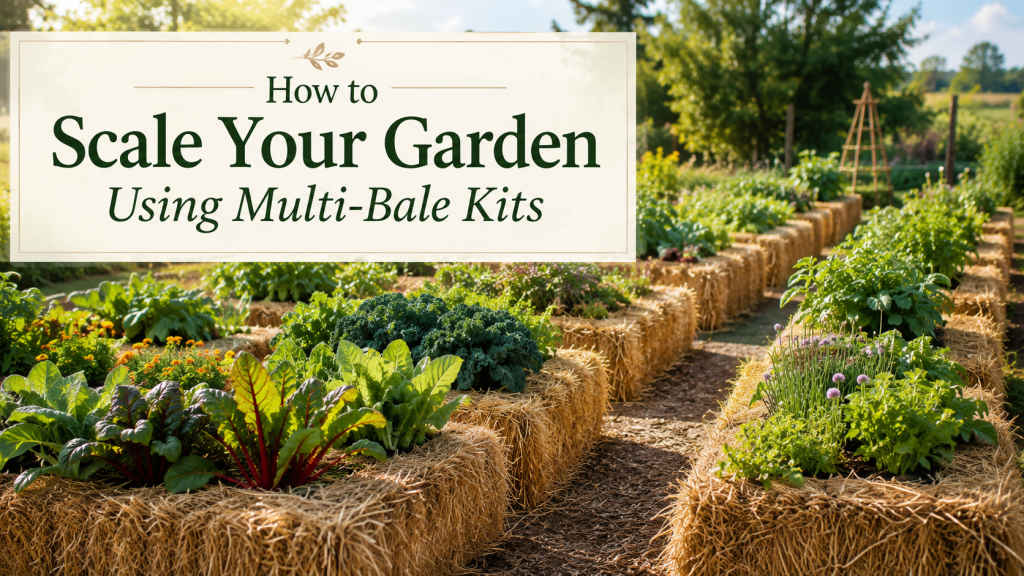
There is a point where one straw bale is no longer enough.
Maybe your first bale worked better than expected. Maybe you want to grow more tomatoes, add herbs, try cucumbers, or create a more organized food garden for the season. Or maybe you already know that one bale will not give you enough growing space for the kind of garden you want.
That is where scaling begins.
Scaling a straw bale garden does not mean making things complicated. It simply means moving from a small setup to a more planned multi-bale system. Instead of treating each bale like a separate experiment, you start thinking in sections, rows, paths, watering zones, and product quantities.
The good news is that straw bale gardening is naturally flexible. You can start with one bale, move to four, then expand again when you are ready. However, as your bale count grows, your planning needs to improve too.
This guide explains how to scale your garden using multi-bale kits, how to choose the right BaleBuster product for your garden size, and how to avoid making the setup harder than it needs to be.
Start by Scaling in Stages
The best way to scale is not always to jump from one bale to twenty.
For many gardeners, the smarter path is gradual.
Start with what you can manage, then expand once you understand how the method works in your own space. A one-bale garden teaches you the basics. A four-bale garden gives you enough room to grow a real mix of plants. A twenty-bale garden is better for someone who already has a clear plan and enough space.
That is why the product path matters.
If you are still testing the method, BaleBuster1 is the one-bale organic formula listed by the shop. If you are ready for a more useful starter setup, BaleBuster4 is made for conditioning four average-size bales. Then, when you are planning a larger garden, BaleBuster20 is the twenty-bale option.
This gives you a natural growth path:
One bale to learn.
Four bales to build.
Twenty bales to scale.
Know Why You Want to Expand
Before buying more bales, ask why you want a larger garden.
That question helps you avoid overbuying.
Some gardeners expand because they want more food. Others want more variety. Some want separate bales for different crops. Meanwhile, some people simply want the garden to look fuller and more organized.
Your reason for scaling will shape your layout.
For example, if you want more crop variety, four bales may be enough. You can dedicate one bale to tomatoes, one to peppers, one to herbs, and one to greens or flowers.
However, if you want a serious seasonal food garden, you may need a larger setup. In that case, twenty bales may make more sense because you can organize the garden into crop zones instead of squeezing everything into a small space.
So before you scale, define the goal.
Are you growing for learning, variety, harvest, beauty, or volume?
Once you know that, the product choice becomes easier.
Choose the Right Multi-Bale Kit for Your Garden Size
The easiest way to buy correctly is to match the kit to the number of bales you are preparing.
This matters because each bale needs proper preparation before planting. If you buy too little product and try to stretch it across too many bales, you may not get consistent results. On the other hand, if you buy much more than you need, you may spend more than necessary.
For a small expansion, BaleBuster4 is the most practical step up from a single bale. The product page describes it as a special formulation for conditioning four average-size bales of straw, hay, or similar bales for growing vegetables, herbs, or flowers.
For larger gardens, BaleBuster20 is built for a bigger setup. The shop lists it as a twenty-bale box with a traditional NPK formulation and a 24 lb. package.
If this is your first time moving beyond one bale, the BaleBuster4 Starter Kit may be the better option because it includes the right amount of BaleBuster to prepare four straw bales plus Joel’s Straw Bale Gardens Complete book.
That makes it useful for gardeners who want both the product and the method in one purchase.
Think in Garden Sections, Not Just Bale Count
A multi-bale garden becomes easier when you divide it into sections.
Instead of thinking, “I have twelve bales,” think:
“This section is for tomatoes.”
“This is for herbs.”
“This section is for greens.”
“This is for climbing crops.”
This helps you plan the garden more clearly.
It also makes watering, harvesting, and plant support easier. For example, tomatoes and cucumbers may need cages, stakes, or trellises. Herbs and leafy greens usually need less support. Therefore, grouping plants by growth habit makes the garden easier to manage.
A four-bale garden might be arranged as one simple section.
A twenty-bale garden may work better as five smaller sections of four bales each.
That way, your large garden still feels manageable.
Use Four-Bale Blocks as a Scaling Unit
One of the simplest ways to scale is to think in four-bale blocks.
Four bales are large enough to create a useful growing area, but small enough to manage without feeling overwhelming. You can repeat the same layout as your garden grows.
For example, one four-bale block could hold:
- Tomatoes and basil
- Peppers and herbs
- Lettuce and greens
- Cucumbers or flowers
If you want to expand, add another four-bale block beside it with a clear walking path between the two.
This approach keeps the garden organized.
Also, it makes product planning easier. Since BaleBuster4 is made for four average-size bales, each four-bale block can be treated as one starter unit. When you move into much larger numbers, BaleBuster20 can support the bigger setup more efficiently.
This structure helps you scale without redesigning everything from scratch.
Leave More Space Than You Think You Need
A common mistake in multi-bale gardens is placing bales too close together.
At first, empty bales look small and easy to reach. However, once plants begin growing, the space fills quickly.
Tomatoes spread. Cucumbers climb. Leaves spill over the sides. Herbs bush out. By mid-season, a tight layout can become difficult to water, prune, and harvest.
So when scaling, leave walking space from the beginning.
You need enough room to:
- Water every bale
- Reach plants without stepping over vines
- Add supports
- Harvest comfortably
- Remove old leaves
- Check plant health
- Move tools through the garden
A multi-bale garden should feel open enough to work in. Otherwise, the larger setup becomes more frustrating than useful.
Plan Water Access Before You Add More Bales
Watering one bale is easy.
Watering four bales is still simple.
but, watering twenty bales requires a plan.
Before scaling, check whether your hose reaches the full garden area. If not, you may need to adjust the layout before the bales are placed. Once the bales are wet and conditioning, moving them becomes much harder.
Place the garden where watering will be convenient, not just where it looks nice.
This is especially important during conditioning. The Straw Bale Gardens method explains that the bale becomes useful as a growing medium after the straw inside begins to decay. On the main Straw Bale Gardens site, Joel Karsten describes straw bale gardening as a container gardening method where the bale itself becomes the container, and conditioning should begin before planting.
Water supports that process. Therefore, scaling without a watering plan creates problems quickly.
Condition Similar Bales Together
When you scale your garden, try to condition your bales on the same schedule.
This keeps the setup easier to manage.
If you start some bales one week and others later, you may end up with different planting dates, different moisture needs, and different stages of readiness. That can work if you are intentionally staggering crops, but it can also create confusion.
For most gardeners, it is easier to:
- Place the full group of bales
- Start conditioning together
- Follow the same timing
- Plant once the bales are ready
This creates consistency across the garden.
It also helps when using a multi-bale product like BaleBuster4 or BaleBuster20 because you can prepare the group as one planned setup instead of treating each bale separately.
Match Crops to the Size of the Setup
Scaling gives you more room, but it also requires better crop choices.
Do not fill a larger garden with random plants just because you have more bales. Instead, match each section to what you actually want to grow and maintain.
A small four-bale garden may be better for:
- Tomatoes
- Peppers
- Herbs
- Greens
- Flowers
A larger garden may allow space for:
- More tomato varieties
- More climbing crops
- Separate herb sections
- Multiple rounds of greens
- A flower section for color
- Larger harvest goals
In addition, consider plant height. Tall crops should not block smaller crops from sunlight. Climbing crops need support. Spreading crops need room.
Scaling is not just about having more bales. It is about using the space well.
Add Support Structures Early
If you are scaling your garden, supports should be part of the initial setup.
Do not wait until plants are already leaning.
Tomatoes, cucumbers, and other tall or climbing crops can become heavy. If you install cages, stakes, or trellises early, the plants can grow into them naturally.
This is much easier than trying to add support after plants are tangled or spilling over.
In a multi-bale garden, support placement also affects layout. For instance, you may want climbing plants near a fence, trellis, or back row. Meanwhile, lower-growing crops can stay closer to the front or path.
Good support planning keeps the garden neat and prevents the larger setup from becoming messy too quickly.
Use a Starter Kit When You Need Method Support
Sometimes the challenge is not buying the product. It is understanding the full process.
That is where a starter kit can help.
If you are moving from interest to action, the BaleBuster4 Starter Kit gives you the four-bale conditioning product plus Joel’s Straw Bale Gardens Complete book. The product page says the book explains the exact process for conditioning the garden.
That matters because a multi-bale garden is easier when you understand what should happen before planting, during conditioning, and after the plants go in.
A starter kit is especially useful if:
- This is your first four-bale setup
- You want product and guidance together
- You are buying for someone new to the method
- You want fewer mistakes in the first season
For larger gardens, it may still help to own the book before scaling because mistakes become more expensive when the garden is bigger.
Keep Notes as You Scale
A bigger garden gives you more to remember.
So, keep simple notes.
Write down:
- How many bales you used
- Which BaleBuster product you bought
- When conditioning started
- When planting started
- What you planted in each bale
- Which crops performed best
- What you would change next time
These notes will make next season easier.
For example, if four bales felt too small, you can expand. If twenty felt like too much, you can scale back. If tomatoes did well but cucumbers needed better support, you will know before the next season begins.
Scaling is not just about adding more bales. It is also about learning from each setup.
Avoid Scaling Too Fast
A larger garden can be exciting, but it also means more watering, more plant care, more harvesting, and more end-of-season cleanup.
Therefore, do not scale faster than your time and space allow.
If one bale worked well, four may be the right next step. If four bales felt easy, then a larger garden may make sense. However, if four bales already felt like a lot, do not rush into twenty.
A successful garden is not always the biggest garden.
It is the garden you can care for well.
Best Product Path for Scaling
Here is the simplest way to think about it.
If you want to test the method, choose BaleBuster1.
You can build a small multi-bale garden with BaleBuster4.
If you want product plus method guidance, choose the BaleBuster4 Starter Kit.
You can prepare a larger twenty-bale setup, choose BaleBuster20.
If you need to learn the method before buying, start with the education resources on Straw Bale Gardens.
Final Thoughts
Scaling a straw bale garden works best when you treat it as a planned system.
Start with your goal. Then count your bales, choose the right BaleBuster product, plan your layout, place the garden near water, and group crops in a way that makes sense.
A one-bale garden helps you learn.
A four-bale garden gives you a useful starter setup.
A twenty-bale garden helps you grow at a larger scale.
The key is to scale with structure, not guesswork.
When your product choice, layout, watering plan, and planting plan all match, a bigger straw bale garden becomes easier to manage and more rewarding through the season.