
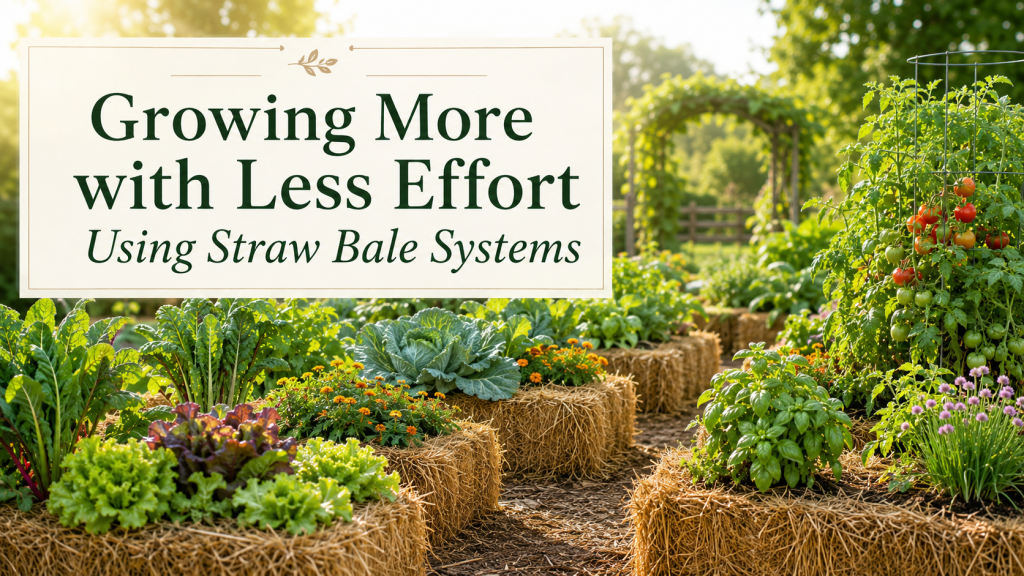
Some gardens look beautiful at the beginning and become exhausting halfway through the season.
There is soil to turn, weeds to pull, beds to repair, drainage problems to manage, and tools that seem to multiply every time a new issue appears. For many gardeners, the dream is not just to grow more. The dream is to grow more without adding more stress.
That is where straw bale systems become useful.
A straw bale garden gives you a ready-made growing structure. Instead of digging into the ground or building raised beds from scratch, the bale becomes the container. Once it has been conditioned, the inside of the bale begins to break down and creates a growing environment for plants.
This does not mean there is no work at all. Every garden needs attention. However, straw bale gardening can remove some of the hardest parts of traditional gardening, especially soil preparation, heavy digging, and constant bed maintenance.
If you want a simpler way to grow vegetables, herbs, or flowers, a straw bale system can help you do more with less effort.
Why Straw Bale Gardening Feels Easier
Traditional gardening often starts with the soil.
You have to know whether the soil drains well, whether it is compacted, whether it needs amendments, whether weeds have taken over, and whether the garden bed is ready to plant.
With straw bale gardening, the starting point is different.
The bale becomes the growing space.
That is one reason the method is helpful for people who do not want to dig, till, or rebuild garden beds every season. The main Straw Bale Gardens education site describes the method as a different type of container gardening, where the straw bale itself becomes the container.
This changes the whole setup.
Instead of spending the early season fighting poor soil, you focus on placing the bales, conditioning them, and planting once they are ready.
As a result, the garden becomes easier to start and easier to manage.
Less Soil Work, More Growing Space
One of the biggest advantages of straw bale systems is that they reduce the need for soil preparation.
You do not need perfect backyard soil. You do not need to till a large garden plot. You do not need to create a traditional raised bed before you can begin.
This is especially useful if your yard has:
- Hard soil
- Poor drainage
- Heavy clay
- Rocky ground
- Limited growing space
- No existing garden bed
Because the bale acts as the growing container, you can set up a garden in places where traditional planting may be difficult.
A patio, driveway edge, side yard, or open sunny spot can become a growing area when the bale is prepared correctly.
That is where the “less effort” part begins. You are not trying to fix the whole ground first. You are building the garden around the bale.
Conditioning Does the Heavy Lifting
The key step in a straw bale system is conditioning.
Conditioning prepares the bale before planting. During this stage, water and nutrients help the inside of the bale begin breaking down. As the straw changes, it becomes a better environment for roots.
This is why the right conditioning product matters.
If you are preparing one bale, BaleBuster1 is the one-bale organic option listed on the shop.
If you want a small garden that gives you more room to grow, BaleBuster4 is made for conditioning four average-size bales.
For a larger setup, BaleBuster20 is the twenty-bale option.
The easier way to think about it is this:
Your bale count decides your BaleBuster product.
That one rule removes a lot of confusion.
Small Start, Bigger Results
You do not need to begin with a large garden.
In fact, starting small may be the easiest way to learn the method without feeling overwhelmed.
A one-bale garden can teach you how the process works. You will see how the bale responds to water, how conditioning changes the inside, and how plants settle into the bale after planting.
However, if you want a more useful starter garden, four bales give you more flexibility.
With four bales, you can separate crops more easily. One bale can hold tomatoes. Another can hold herbs. Another can be used for peppers, greens, or flowers.
That is why BaleBuster4 works well for many beginner gardens. It gives you enough growing space to see what the system can really do, while still keeping the setup manageable.
Instead of expanding too quickly, you can grow in stages.
First, learn the method.
Next, build a small system.
Then, scale when you are ready.
Easier Access Means Easier Gardening
Straw bales sit above ground level.
That alone can make gardening feel easier.
You do not have to bend as far as you would with a flat soil bed. Planting, watering, checking leaves, adding support, and harvesting can feel more accessible.
This is especially helpful for gardeners who want a simpler setup or prefer not to spend so much time working at ground level.
In addition, bales can be arranged to fit the gardener’s space.
You can create a straight row, a small four-bale block, or a larger garden with walking paths. The key is to leave enough room to reach every bale comfortably.
A garden that is easy to reach is easier to maintain.
And when a garden is easier to maintain, you are more likely to stay consistent through the season.
Watering Becomes More Organized
A straw bale system also helps you think about watering in a more structured way.
Instead of watering a large uneven soil bed, you are watering defined growing units. Each bale is its own container, which makes the garden easier to observe.
For example, if one bale dries out faster than the others, you can notice it and adjust. If a section of the garden gets more sun, you can respond more quickly.
However, watering still needs planning.
Place the bales close to a water source before conditioning begins. Once they are wet, they become heavier and harder to move.
For one or two bales, a watering can may be enough. For four bales, a hose is usually easier. For larger gardens, water access becomes even more important.
The less effort approach is simple: place the garden where watering will not become a daily problem.
A Better System for Busy Gardeners
Many people want to grow food, but they do not have unlimited time.
A straw bale system can work well because it simplifies the early setup. Rather than spending weekends digging, building, and improving soil, you can focus on the main process:
Place the bales.
Condition them.
Plant when ready.
Water and maintain through the season.
That structure is easier to follow than trying to solve every soil and bed problem at once.
Also, because the system is modular, you can choose the size that fits your life.
A busy gardener may start with one or four bales.
A family may choose a four-bale setup for herbs, tomatoes, peppers, and greens.
A more serious gardener may use a larger setup with BaleBuster20.
The point is not to grow the biggest garden possible.
The point is to grow a garden you can actually maintain.
Multi-Bale Systems Make Scaling Easier
Once you understand the method, scaling becomes simple.
You do not need to redesign the whole garden from scratch. You can add more bales in organized groups.
For example, a four-bale system can become the basic unit of your garden.
One four-bale section may grow tomatoes and herbs.
Another may grow peppers and greens.
A third may grow flowers or climbing crops.
This keeps the garden structured. It also makes buying easier because you can match your bale count to the right BaleBuster product.
If you are moving from a small garden to a larger one, the BaleBuster4 Starter Kit can help because it combines the four-bale product with Straw Bale Gardens Complete. That makes sense for gardeners who want both the product and the full method together.
As your garden grows, the system stays repeatable.
That is what makes scaling less intimidating.
Fewer Weeds, Less Frustration
One of the reasons people get tired of gardening is weeds.
Weeds take time. They compete with plants. They make the garden look messy. They also turn a relaxing hobby into another chore.
Straw bale gardening can reduce that pressure because you are not planting directly into a traditional soil bed filled with weed seeds.
That does not mean you will never see unwanted growth. However, the setup can make weed pressure easier to manage compared to many ground gardens.
Because the growing area is raised and defined, problems are easier to spot.
You can see what belongs in the bale and what does not.
That saves time and helps the garden stay cleaner.
Less Bed Building and Fewer Permanent Decisions
Raised beds are useful, but they require materials, tools, space, and commitment.
A straw bale system is more flexible.
You can test a garden in one area this season and move the layout next season. You can start with a few bales, then expand. You can adjust based on sunlight, water access, and what worked best.
That flexibility helps gardeners avoid expensive mistakes.
For example, if you are not sure where your garden should go, starting with bales can be less permanent than building a full raised bed structure.
You can learn from the season before making bigger decisions.
That is a practical way to grow with less pressure.
What to Buy for a Low-Effort Start
The easiest setup depends on your garden size.
If you want to test the method, start with one bale and BaleBuster1.
If you want a practical starter garden, use four bales and BaleBuster4.
If you want product and learning support together, choose the BaleBuster4 Starter Kit.
If you want to prepare a larger garden, use BaleBuster20.
Beyond that, keep your tools simple:
- Watering can or hose
- Gloves
- Hand trowel
- Plant supports
- Seeds or seedlings
- Plant labels if needed
You do not need to overbuy.
Start with the system first. Then add only what your garden actually needs.
Common Mistakes That Make the Garden Harder
Straw bale systems are meant to simplify gardening, but a few mistakes can make them harder than necessary.
Starting too big too soon
A large garden is exciting, but it also needs more watering and planning. Start with a size you can manage.
Placing bales too far from water
This makes daily care more tiring. Choose convenience before appearance.
Buying the wrong BaleBuster size
Count your bales before choosing a product.
Planting before the bales are ready
Conditioning needs time. Rushing can lead to weak early growth.
Crowding the bales
Plants need access, airflow, and room to grow. Leave walking space from the start.
Skipping learning support
If you are new, a guide or starter kit can prevent confusion.
Small decisions at the beginning can save a lot of effort later.
How to Keep the System Easy All Season
After planting, the garden still needs regular care.
However, you can keep the work light by creating a simple routine.
Check moisture often. Add supports early. Harvest regularly. Remove dead leaves when you see them. Watch for plants that need more space.
Also, keep notes.
Write down which crops grew well, which bales performed best, and what you would change next season.
These notes make the next garden easier because you are not starting from memory.
With each season, your straw bale system becomes more familiar and more efficient.
Final Thoughts
Growing more with less effort does not mean ignoring the garden.
It means building a better system from the beginning.
Straw bale gardening helps by reducing soil preparation, cutting down on digging, creating raised growing spaces, and giving gardeners a flexible way to start small or scale up.
The method works best when you choose the right BaleBuster product for your bale count, place the bales near water, condition them properly, and keep the layout easy to manage.
Start with one bale if you want to learn.
Choose four bales if you want a strong beginner setup.
Move to twenty bales when you are ready for a larger system.
The easier garden is not always the smallest garden.
It is the one designed well from the start.