
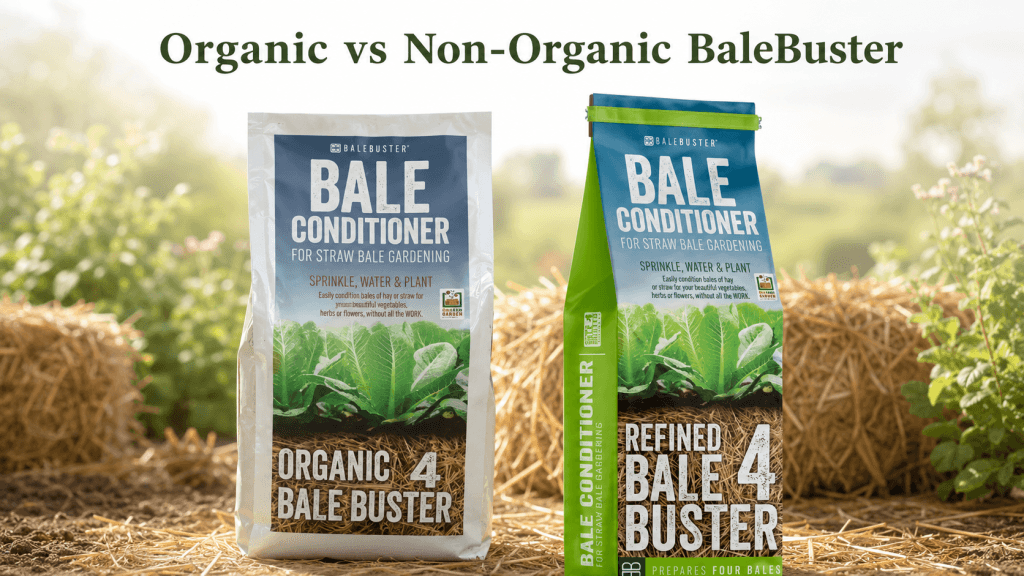
Choosing between organic and non-organic BaleBuster is mostly about your gardening preference, your bale count, and how you want to condition your straw bales.
Both options help prepare straw bales before planting. Both support the conditioning process. Both are designed for Straw Bale Gardening.
The difference comes down to the formula.
Organic BaleBuster options use organic ingredients, while the non-organic options use a traditional NPK formulation. That means the products support the same goal, but they do it with different nutrient sources.
If you are trying to decide which one to buy, the best starting question is simple:
Do you want an organic conditioning formula, or do you want the standard traditional BaleBuster option that matches your garden size?
This guide breaks down the difference so you can choose the right product before planting season begins.
What BaleBuster Does First
Before comparing organic and non-organic options, it helps to understand what BaleBuster is meant to do.
A fresh straw bale is not ready for planting immediately. It needs to go through conditioning first. During conditioning, water and nutrients help activate microbial activity inside the bale.
As that process begins, the straw starts to break down. The bale becomes warmer, softer, and more useful for plant roots.
That is the role of BaleBuster.
It helps prepare the bale before seedlings or seeds go in.
Without proper conditioning, the bale may stay too dry, too stiff, or too low in available nutrients. Plants may struggle because the root zone is not ready yet.
So, whether you choose organic or non-organic BaleBuster, the goal stays the same: condition the bale so it becomes a better growing environment.
What Organic BaleBuster Means
Organic BaleBuster is made for gardeners who want to condition their bales using an organic formula.
If you are starting with one bale, BaleBuster1 is the one-bale organic option listed on the shop.
For a larger organic setup, BaleBuster5 Organic fits a five-bale garden.
Organic options make sense if you care about the source of your conditioning inputs. They also fit gardeners who prefer an organic approach from the beginning.
However, organic conditioning may come with a few natural trade-offs.
Organic nitrogen sources can smell during decomposition. They may also attract flies for a short period while the bale is breaking down. That does not automatically mean something is wrong. It is part of how some organic materials behave during decomposition.
If your garden sits close to a patio, doorway, or shared outdoor space, keep that in mind before choosing an organic product.
What Non-Organic BaleBuster Means
Non-organic BaleBuster refers to the traditional NPK formulation options.
These products use refined nutrient sources instead of organic nitrogen sources. The shop lists BaleBuster4 as the four-bale conditioning product, while BaleBuster20 is the twenty-bale option with a traditional NPK formulation.
This type of formula works well for gardeners who want a practical, straightforward conditioning product without choosing the organic route.
It may also be a better fit for people who want a cleaner experience around the home, especially if they want to avoid the temporary odor that can come with some organic materials.
Non-organic does not mean careless.
It simply means the formula uses traditional nutrient sources to feed the conditioning process.
Organic vs Non-Organic BaleBuster: The Simple Difference
Here is the clean version.
Organic BaleBuster is for gardeners who want an organic formula.
Non-organic BaleBuster is for gardeners who are comfortable using a traditional NPK formulation.
Both options support bale conditioning.
Your decision depends on what matters more to you:
Formula preference.
Bale count.
Garden location.
Ease of use.
Odor tolerance.
Budget.
First-time gardeners often focus only on organic vs non-organic. That can matter, but bale count matters just as much.
A one-bale garden needs a one-bale product.
A four-bale garden needs a four-bale product.
A twenty-bale garden needs a larger option.
If you choose the right formula but the wrong size, the setup can still become confusing.
Choose Organic BaleBuster If This Sounds Like You
Organic BaleBuster may be the better choice if you want your conditioning process to follow an organic approach.
It also fits gardeners who prefer organic inputs from the start and do not mind the natural smell that may come during decomposition.
Choose organic if:
- You want an organic bale conditioning formula.
- You are preparing one bale and want a small organic setup.
- You are preparing five bales and want the organic garden-size option.
- You are comfortable with temporary odor during decomposition.
- You prefer organic inputs even if the process feels a little more “earthy.”
For one bale, choose BaleBuster1.
For five organic bales, choose BaleBuster5 Organic.
If you want a five-bale organic setup plus a book, the BaleBuster5 Starter Package gives you the BaleBuster5 organic formula with a Straw Bale Gardens book.
Choose Non-Organic BaleBuster If This Sounds Like You
Non-organic BaleBuster may be the better choice if you want the traditional formula and a product size that fits a four-bale or twenty-bale setup.
Many first-time gardeners start with four bales because that size gives them a real garden without becoming too much to manage.
For that setup, BaleBuster4 is the simple match.
If you want to prepare a bigger garden, BaleBuster20 fits a twenty-bale plan.
Choose non-organic if:
- You want the traditional NPK formulation.
- You are preparing four average-size bales.
- You are preparing a twenty-bale garden.
- You want a straightforward conditioning product.
- You prefer not to use organic nitrogen sources that may smell during decomposition.
This option works well for practical gardeners who want the product to match their bale count clearly.
What About First-Time Gardeners?
First-time gardeners should not overcomplicate the decision.
If you want a small test, start with one bale and BaleBuster1.
If you want a better first garden, four bales with BaleBuster4 may make more sense.
If you want product plus instruction, the BaleBuster4 Starter Kit includes BaleBuster4 and Straw Bale Gardens Complete.
That bundle helps beginners because it gives them both the conditioning product and the method.
A product can help prepare the bale, but instruction helps you avoid mistakes.
If you are new, guidance matters.
Organic Does Not Mean You Can Skip the Process
Organic BaleBuster still needs proper use.
The bale must be watered. The product must reach the straw. Microbes still need time to work. Planting too early can still hurt your results.
Some beginners assume organic means gentler, easier, or automatic.
That is not the right way to think about it.
Organic conditioning still follows the same basic science. The bale needs moisture, nutrients, microbial activity, and time.
So, even with organic BaleBuster, do not rush planting.
Wait until the bale has gone through the conditioning period and shows signs of readiness.
Non-Organic Does Not Mean the Method Changes
Traditional BaleBuster options also need the same careful setup.
Place the bales first.
Keep water nearby.
Apply the product according to the instructions.
Watch the bale during conditioning.
Plant only when the bale is ready.
The formula type may change, but the method remains the same.
A non-organic product does not remove the need for good timing. It simply uses a traditional nutrient formulation to support the conditioning process.
Compare by Garden Size
The easiest way to choose is by bale count.
For one bale, use BaleBuster1.
For four bales, use BaleBuster4.
For five organic bales, use BaleBuster5 Organic.
For twenty bales, use BaleBuster20.
For four bales plus the book, choose the BaleBuster4 Starter Kit.
For five organic bales plus the book, choose the BaleBuster5 Starter Package.
This keeps the choice practical.
Pick the formula you prefer, then match the product to the number of bales.
Compare by Gardening Goal
Your garden goal can also guide the decision.
A patio gardener may want one bale and an organic formula.
A beginner with backyard space may prefer four bales and a starter kit.
An organic gardener may want the five-bale organic option.
A school, homestead, or larger backyard garden may need BaleBuster20.
The best product depends on what you are building.
Do not choose based only on what sounds best. Choose based on the garden you actually plan to manage.
A small, well-prepared garden usually beats a large garden that feels stressful from day one.
Common Buying Mistakes
One mistake is choosing organic or non-organic before deciding how many bales to grow in.
Start with bale count.
Another mistake is stretching one product across too many bales. That can create uneven conditioning.
Some gardeners also buy seedlings too early. Wait until the bales are close to ready before bringing home live plants.
A fourth mistake is ignoring garden location. If the bales sit far from water, the conditioning process becomes harder to manage.
Finally, do not buy a starter kit if you will not use the book. On the other hand, do not skip the book if you need guidance.
Buy what supports your actual first season.
Which One Should You Buy?
Choose organic BaleBuster if your priority is an organic conditioning formula.
Choose non-organic BaleBuster if you want the traditional NPK formulation.
After that, let your bale count decide the product.
Here is the easiest guide:
- One organic bale: BaleBuster1
- Four-bale starter garden: BaleBuster4
- Four-bale starter garden with book: BaleBuster4 Starter Kit
- Five organic bales: BaleBuster5 Organic
- Five organic bales with book: BaleBuster5 Starter Package
- Twenty-bale garden: BaleBuster20
That is the cleanest way to choose without overthinking it.
FAQ: Organic vs Non-Organic BaleBuster
What is the main difference between organic and non-organic BaleBuster?
Organic BaleBuster uses an organic formula, while non-organic BaleBuster uses a traditional NPK formulation. Both support the bale conditioning process.
Is organic BaleBuster better?
Organic is better if you specifically want organic inputs. It is not automatically the best choice for every gardener. Your bale count and setup still matter.
Does organic BaleBuster smell?
Organic nitrogen sources may create temporary odor during decomposition. That can happen while the bale is conditioning.
Which BaleBuster should a beginner choose?
Many beginners choose BaleBuster4 or the BaleBuster4 Starter Kit because four bales create a useful first garden, and the kit includes the book for guidance.
Which product should I use for a larger garden?
BaleBuster20 is the twenty-bale option and fits larger straw bale garden setups.
Final Thoughts
Organic and non-organic BaleBuster products both support the same basic goal: preparing straw bales before planting.
The difference comes from the formula.
Organic options fit gardeners who want organic inputs. Traditional NPK options fit gardeners who want the standard BaleBuster formula for four-bale or twenty-bale setups.
Do not make the choice harder than it needs to be.
Decide whether you want organic or traditional.
Count your bales.
Choose the product that matches.
Then condition your bales properly before planting.