
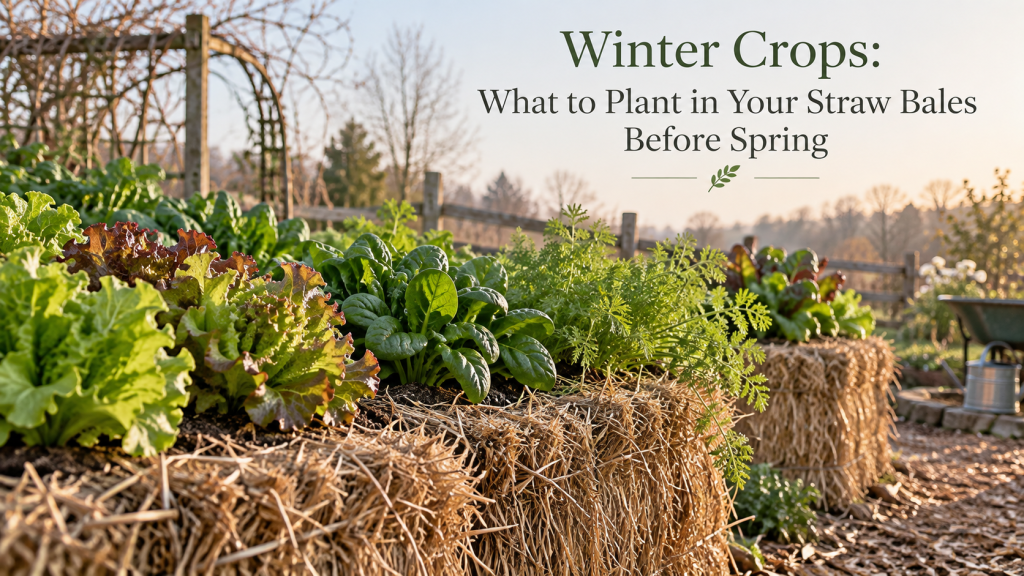
Your strawbale garden does not have to sit completely empty after the summer harvest. If your bales still have enough structure to remain in place through fall and winter, a simple cover crop can keep living roots growing for part or all of the off season. Depending on your climate and what you plant, the cover crop may die naturally during winter or survive until spring.
The key is choosing a crop that fits your climate, your spring plans, and the condition of the bale.
A fresh bale still needs to be conditioned before planting. A second-year bale has already gone through months of decomposition, so it behaves more like a mature growing medium. Official Straw Bale Gardens guidance notes that these older bales can work especially well for cool-season crops.
Can You Grow in Straw Bales During Winter?
Yes, depending on your climate.
The Straw Bale Gardens method can be used in different climates and seasons, including winter gardens where conditions allow. The method works because the bale itself becomes the growing container and rooting environment as the straw decomposes.
The most important question is not simply whether it is winter.
It is whether:
- The bale still holds together
- The crop suits cooler weather
- Your climate allows continued growth
- The bale has already been conditioned from the previous season
For many gardeners, the easiest winter or early-spring use for an older bale is growing cool-season crops.
Best Crops for Second-Year Straw Bales
Official Straw Bale Gardens guidance specifically recommends second-year bales for crops such as:
- Lettuce
- Spinach
- Carrots
- Potatoes
These crops are well suited to older bales because second-year bales have already decomposed significantly and no longer produce the same internal heat as freshly conditioned bales.
1. Lettuce
Lettuce is one of the simplest crops to grow in an older bale.
It prefers cooler conditions compared with many summer vegetables, and the decomposed interior of a second-year bale can provide a useful growing environment.
Lettuce is also a practical choice when you want to continue using a bale without committing to a long growing season.
For direct seeding, the official Straw Bale Gardening guidance recommends using a shallow layer of clean potting mix over the surface of the bale to create a seed bed.
2. Spinach
Spinach is another cool-season crop specifically mentioned for second-year bales.
Like lettuce, it is well suited to cooler temperatures and can be planted into a bale that has already completed its main decomposition cycle.
Because second-year bales do not need to be conditioned again, spinach can be planted earlier than you would plant into a fresh, newly conditioned bale.
3. Carrots
Carrots can also perform well in second-year bales.
By the second growing season, the interior of the bale has softened significantly. This gives root crops a looser growing environment than they would have had in a brand-new bale.
Official Straw Bale Gardens guidance identifies carrots as one of the crops particularly suited to second-year bales.
4. Potatoes
Potatoes are another strong option for older straw bales.
They are specifically listed by Straw Bale Gardens as a crop that can work well in second-year bales.
An older bale gives the roots access to material that has already softened and decomposed substantially during the previous season.
Why Second-Year Bales Work Differently
A fresh bale begins as a compact bundle of dry straw.
Before planting, it must go through the conditioning process. During conditioning, water and nutrients encourage microorganisms to begin breaking down the straw. The interior warms and gradually becomes softer and more compost-like.
By the second growing season, much of that process has already happened.
That is why official Straw Bale Gardening guidance says second-year bales generally do not need conditioning again.
This also means they are better suited to cool-season crops than heat-loving plants that benefit from the warming process of a fresh bale.
What Should You Plant in Fresh Bales Instead?
Fresh bales are better suited to the normal spring and summer Straw Bale Gardens setup.
Official guidance specifically mentions warm-season crops such as:
- Tomatoes
- Peppers
- Cucumbers
Fresh bales go through the heating and cooling process during conditioning, which helps create the rooting environment these crops use during the first season.
If you are starting with fresh bales, follow the official Straw Bale Gardens setup and conditioning process before planting. How to Start Straw Bale Gardening
Do Second-Year Bales Need BaleBuster?
Not usually.
A second-year bale has already undergone significant decomposition and does not need to be treated like a brand-new bale.
Fresh bales are different.
New straw must be conditioned before planting, and BaleBuster is designed specifically to help prepare fresh straw bales by encouraging decomposition.
For gardeners replacing old bales with new ones, BaleBuster is available in different package sizes for different garden setups. Shop BaleBuster products
What If the Bale Starts Falling Apart?
A second-year bale may begin losing its shape as decomposition continues.
That does not automatically mean it has to be discarded.
Official Straw Bale Gardens guidance recommends wrapping a weakening bale with chicken wire and securing it with a wooden stake when necessary. This can help keep the decomposing material together and prevent roots from becoming exposed.
If the bale has broken down too far to remain useful as a growing container, it may be better used as organic material elsewhere in the garden.
What Happens When the Bale Is Finally Finished?
A bale does not become useless when it can no longer support another crop.
As it decomposes, the straw becomes valuable organic material.
Official Straw Bale Gardens guidance notes that decomposed straw can be:
- Added to compost
- Used around garden beds
- Used as mulch where appropriate
- Incorporated into future garden areas
That means even a bale that has reached the end of its life as a planting container can still contribute to the garden.
Can You Leave Fresh Bales Outside Over Winter?
Yes.
Joel Karsten has also explained that gardeners can buy fresh straw bales in fall, place them where they will be used, and leave them exposed to rain and snow through winter.
They do not need to be covered. Allowing them to sit outside can begin the natural breakdown process before spring.
However, these are still fresh bales and should go through the proper conditioning process before spring planting.
A Simple Winter Plan
If your bales are still in good condition after summer:
Use second-year bales for:
- Lettuce
- Spinach
- Carrots
- Potatoes
Replace badly decomposed bales when:
- The structure has almost disappeared
- The bale can no longer contain roots properly
- The material is better suited for compost
Use fresh bales when:
- You want to grow warm-season crops
- You are starting a new section of the garden
- The old bales are no longer stable
Fresh bales should be conditioned before planting. Learn the Straw Bale Gardens method
Frequently Asked Questions
Can you use straw bales for a second growing season?
Yes. Straw Bale Gardens guidance says sufficiently intact second-year bales can be reused and are especially useful for cool-season crops such as lettuce, spinach, carrots, and potatoes.
Do second-year straw bales need conditioning?
No. Official guidance states that second-year bales have already decomposed significantly and generally do not need to go through the conditioning process again.
What can I grow in an old straw bale?
Lettuce, spinach, carrots, and potatoes are specifically recommended for second-year bales.
Can I leave new straw bales outside all winter?
Yes. Joel Karsten recommends placing fall-purchased bales where they will eventually be used and allowing them to remain exposed to winter weather.
What should I do when an old bale falls apart?
If it is still usable, reinforce it with chicken wire and a stake. If it has decomposed too far, use the material as compost or organic matter elsewhere in the garden.
Keep Your Straw Bale Garden Working Longer
The end of summer does not necessarily mean the end of your straw bale garden.
If your bales still hold together, they may continue producing cool-season crops before spring.
Use second-year bales for crops such as lettuce, spinach, carrots, and potatoes. Save fresh bales for the next main growing season, and condition those new bales properly before planting.
When an old bale finally reaches the end of its useful life, let the decomposed straw continue working for you as compost or organic material elsewhere in the garden.
For gardeners starting again with fresh bales, explore the available conditioning options in the Straw Bale Garden Shop.