
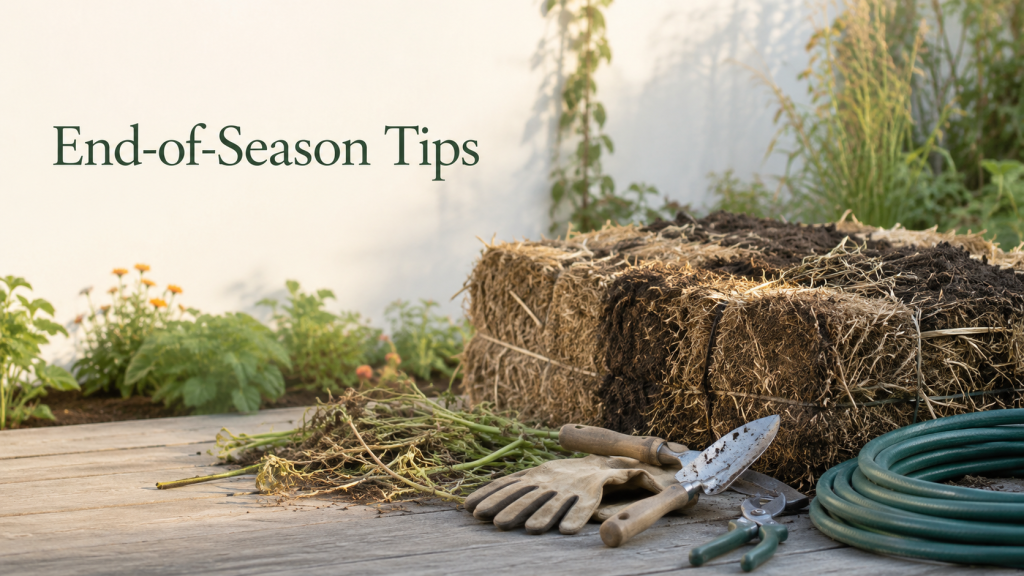
By the end of the growing season, a straw bale garden looks very different from the day it started.
The bales are softer. The plants have finished producing. Some bales may be sagging, leaning, or breaking apart. The garden may look messy, but that is not a bad thing. It usually means the bales have done their job.
In straw bale gardening, the bale is not just a container. It slowly becomes part of the growing system. As the inside breaks down, it turns into a compost-like material that supports plant roots during the season. By the end of the year, that same material can still be useful if you handle it correctly.
So before you clear everything away, it is worth slowing down and deciding what should be reused, what should be composted, what tools need cleaning, and what products you should prepare for next season.
This guide walks you through what to do with your bales and tools after the growing season ends, so your garden closes well and next season starts easier.
Start by Removing Finished Plants
Once your crops are finished producing, start by removing the old plant material.
Pull out dead tomato vines, pepper plants, cucumber stems, herbs, flowers, and any other spent plants. If the plants were healthy, you can add them to your compost pile. If any plants had disease issues, it is better to dispose of those separately instead of mixing them into compost you plan to reuse.
This is also a good time to remove:
- Plant labels
- Twine used for tying plants
- Old trellis ties
- Broken stakes
- Plastic clips
- Any leftover garden debris
The cleaner your garden is at the end of the season, the easier it will be to prepare for the next one.
Do not worry if the bales look soft or partially collapsed. That is expected. The decomposition that helped your plants grow during the season continues after harvest.
Check the Condition of Each Bale
Not every bale ends the season in the same condition.
Some bales may still be fairly intact. Others may be loose, dark, soft, and almost fully broken down.
Walk through the garden and separate the bales into three groups:
- Bales that still hold their shape
- Bales that are mostly decomposed
- Bales that are falling apart completely
The bales that are still holding together may be useful for a second season, depending on what you want to grow and how much structure remains.
The ones that are mostly decomposed can be used as compost, mulch, or garden amendment.
The bales that are falling apart can be moved directly into compost piles, garden beds, or areas where you want to improve organic matter.
This is where straw bale gardening gives you an extra benefit. Even after the plants are done, the bale still has value.
Reuse Partially Decomposed Bales When Possible
If a bale still has enough structure, you may be able to reuse it in some way.
Second-year bales will not behave exactly like fresh bales. They are already partly broken down, softer, and less likely to heat up like a new bale during conditioning. That makes them better suited for certain uses rather than treating them exactly like a first-year bale.
You can use old bales as:
- A base layer for garden beds
- Mulch around plants
- Compost material
- Filler for raised beds
- Organic matter for poor soil areas
- A soft growing area for certain crops
For example, the Straw Bale Gardens article on growing potatoes describes a simple harvest method where the strings are cut, the bale is knocked over, and the potatoes are picked up without digging. That same idea shows how loose and easy-to-handle an end-of-season bale can become after it has broken down through the year.
If your bales are still in reasonable shape, keep them nearby until you decide how to reuse them.
Turn Broken-Down Bales into Compost
A heavily decomposed bale should not be seen as waste.
By the end of the season, much of that straw has already started turning into organic material. You can move it into your compost pile or spread it where organic matter is needed.
Use old bale material to:
- Add bulk to compost
- Cover bare soil
- Improve garden beds
- Mulch around perennials
- Fill low spots in planting areas
- Mix into areas that need more organic matter
If you are composting the material, break it apart so it blends more easily with other compost ingredients.
Avoid adding diseased plant material if you had serious disease problems during the season. Keep the bale material cleaner by removing old roots, stems, and plant debris before moving it.
The goal is to preserve what is useful and avoid carrying over problems.
Save Good Stakes, Trellises, and Supports
If you used stakes, trellises, cages, or wire supports, do not leave them outside all winter without checking them.
Remove them from the garden, shake off loose straw and soil, and inspect them carefully.
Keep anything that is still strong and safe to use.
Set aside anything that is broken, rusty, weak, or bent beyond repair.
Large plants like tomatoes, cucumbers, and climbing crops often need support during the season. Reusing good supports saves money next year, but only if they are cleaned and stored properly.
Before storing them:
- Brush off dirt and straw
- Remove old ties and clips
- Check for cracks or rust
- Stack neatly
- Store in a dry place
This is also a good time to make a note of what you wished you had more of. If your tomatoes needed stronger support or your cucumber vines ran out of space, write it down now before you forget.
Clean Your Hand Tools Before Storage
Garden tools last longer when they are cleaned before storage.
At the end of the season, clean your hand trowel, pruning shears, gloves, watering cans, and any small tools used around the bales.
Remove soil, straw, and plant residue. Dry metal tools properly before storing them so they do not rust.
For pruning shears or cutting tools, wipe the blades and check whether they need sharpening. If any tools were used on diseased plants, clean them more carefully before storing.
A simple end-of-season tool cleanup should include:
- Removing dirt and straw
- Drying tools completely
- Checking handles
- Sharpening blades if needed
- Replacing broken gloves
- Storing tools in a dry location
This is not just about neatness. It makes the next growing season easier because you will not be looking for dirty, damaged, or missing tools when it is time to start again.
Drain and Store Watering Equipment
Watering equipment is easy to forget after the garden slows down, but it matters.
If you used a hose, watering can, drip line, or soaker hose, clean and store them properly before cold weather causes damage.
Disconnect hoses, drain out remaining water, and coil them neatly. If water sits inside hoses during freezing weather, it can damage them.
Check for:
- Leaks
- Cracks
- Loose fittings
- Clogged watering heads
- Damaged connectors
If something needs replacing, make a note now. You do not have to buy everything immediately, but you should know what needs attention before spring.
If you plan to expand next season, this is also a good time to decide whether your watering setup was enough. One or two bales can be handled with a watering can. A larger garden needs easier water access.
On the Straw Bale Gardens education site, the method is presented in three simple stages: position the bale, condition it, then plant and grow. Water is part of that process from the beginning, so your watering setup should be treated as part of the garden system, not an afterthought. You can review the method on the main Straw Bale Gardens learning site.
Review What Worked This Season
Before you fully close the garden, take a few minutes to review the season.
This is where many gardeners miss an opportunity.
Do not rely on memory. Write down what happened while it is still fresh.
Ask yourself:
- Which crops grew best?
- Which crops struggled?
- Did I start conditioning early enough?
- Did I buy the right BaleBuster size?
- Did the bales get enough sun?
- Was watering easy or stressful?
- Did I need better plant support?
- Did I start with too many or too few bales?
- What would I change next year?
This review will help you buy smarter for the next season.
If you started with one bale and enjoyed the process, next year may be the right time to expand. If it is with four bales and felt comfortable, you may want to add more. Also, If you had too much to manage, keep it smaller next time.
The end of the season is the best time to make those decisions because the experience is still clear.
Decide What You Will Need Next Season
Once you know what worked, start planning your next product needs.
If you plan to start again with a single bale, BaleBuster1 is the one-bale organic formula listed on the shop.
If you want a small starter setup or plan to grow with four average-size bales, BaleBuster4 is designed for that four-bale size.
But If you are preparing a larger garden, BaleBuster20 is the twenty-bale option listed with a traditional NPK formulation.
If this season felt confusing and you want better guidance next time, the BaleBuster4 Starter Kit includes BaleBuster4 with the Straw Bale Gardens Complete book, which is helpful for gardeners who want the product and the method together.
The key is to buy based on your next garden size, not based on guesswork.
Store Leftover Supplies Properly
If you have leftover garden supplies, store them carefully.
Keep books, guides, labels, gloves, tools, and unused materials in a dry place. Do not leave paper materials where moisture can damage them.
For product-specific storage, follow the instructions on the package label. If you are unsure about whether a product should be stored for next season, check the product page or contact the shop before relying on it later.
A clean storage system can be as simple as one labeled bin for straw bale gardening supplies.
Inside, keep:
- Gloves
- Labels
- Small tools
- Plant ties
- Garden notes
- Guides or booklets
- Product instructions
- Seed packets if still usable
When spring returns, you will already know where everything is.
Use the Off-Season to Learn More
The off-season is a good time to improve your method.
During the growing season, it is easy to focus only on watering, harvesting, and solving immediate problems. After the season ends, you have more time to understand what happened and prepare better.
If you want a deeper explanation of the method, the Straw Bale Gardening booklet by Joel Karsten is a useful resource to keep on hand.
You can also use the education content on strawbalegardens.com to revisit the basics before planning next year’s garden.
This is especially helpful if you had problems such as poor growth, late planting, uneven watering, or uncertainty about conditioning timing.
Learning during the off-season makes the next season less stressful.
Avoid These End-of-Season Mistakes
A few mistakes can make next season harder than it needs to be.
Do not leave tools outside all winter.
Don’t leave hoses full of water in freezing weather.
Do not throw away decomposed bale material if it can be composted or reused.
Don’t forget to write down what worked.
Do not assume you will remember your bale count, plant layout, or product choice next spring.
Do not wait until planting season to decide what to buy.
End-of-season cleanup is not just about closing the garden. It is about setting up the next one.
A Simple End-of-Season Checklist
Use this quick checklist before you finish for the year:
- Remove finished plants.
- Separate healthy plant material from diseased material.
- Check which bales can be reused or composted.
- Move broken-down bale material to compost or garden beds.
- Clean hand tools.
- Drain and store hoses.
- Save usable stakes, cages, and trellis materials.
- Throw away broken or unsafe supports.
- Review what grew well.
- Write down what to change next season.
- Decide which BaleBuster product fits your next garden.
- Store guides, tools, and supplies in one dry place.
This kind of cleanup may only take a little time, but it makes a big difference later.
Final Thoughts
The end of the growing season is not the end of your straw bale garden’s usefulness.
Your bales can become compost, mulch, bed filler, or organic matter for other parts of the garden. Tools can be cleaned and stored. Your notes can help you make better decisions next season.
Most importantly, your experience from this season can guide what you buy and how you prepare next time.
If one bale worked well, you may choose to expand.
Four bales feels right, you may repeat the same setup.
If you are ready for a larger garden, you can plan ahead and choose the product size that matches your next bale count.
A better next season starts at the end of this one.
Clean up well, reuse what you can, store your tools properly, and plan your next straw bale garden with more confidence.